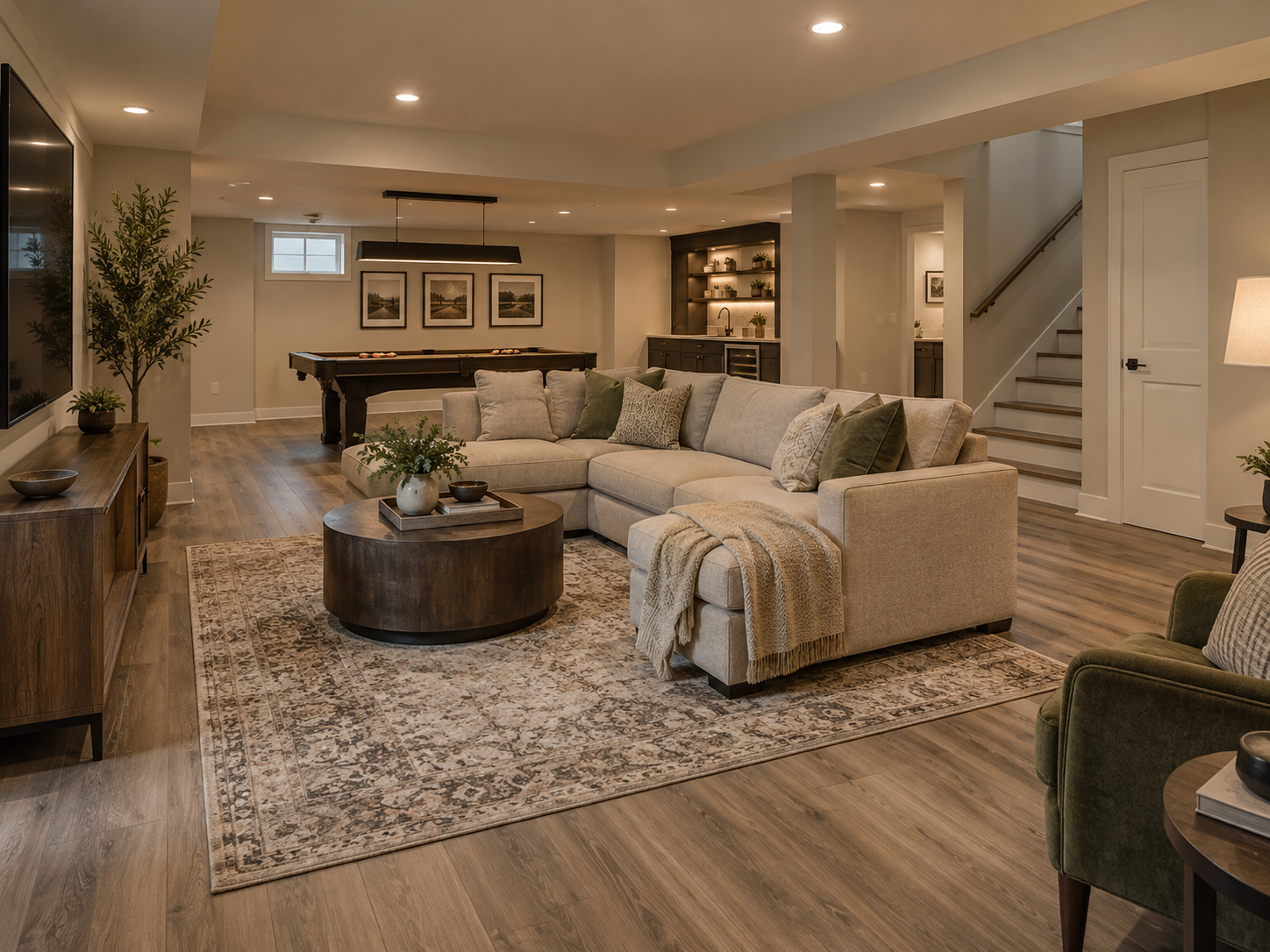
Silver Spring homeowners finishing a basement almost always land on the same flooring question. Carpet feels warm but holds moisture. Tile is durable but cold and hard underfoot. Luxury vinyl plank, or LVP, has become the default answer for good reason: it handles the humidity of a below-grade room in the Silver Spring area better than almost anything else, and it still looks like real wood.
This guide walks through why LVP works below grade, what has to happen before it goes down, and where the real costs sit in a basement flooring project.
At H&C Construction Design Build, we serve Silver Spring homeowners with Basement Remodeling and flooring built for below-grade rooms. Here is what Silver Spring homeowners should know before installing LVP in 2026, including how we sequence basement remodeling around a dry slab.
Why LVP Belongs Below Grade in Silver Spring
Maryland summers push a lot of humidity into a below-grade space, even in a basement that never floods. Solid hardwood expands and contracts with that moisture and can cup or gap over a few seasons. LVP is built from a rigid core that shrugs off humidity swings instead of reacting to them.
Finished rec rooms take daily abuse from kids, pets, and foot traffic straight off a driveway. A quality LVP wear layer resists scratches and stands up to a mop far better than carpet ever will, and it never needs the periodic refinishing a hardwood floor eventually asks for.
Silver Spring’s mix of older ramblers and newer townhomes means basement ceiling height and slab condition vary block to block. A thinner LVP profile helps in a lower-ceiling basement where every fraction of an inch matters, while a thicker, more rigid plank suits a room with a less-than-perfectly-flat slab. Matching the product to the actual room, not just the budget, is where a lot of DIY flooring jobs go wrong.
The Moisture Checklist Before Flooring Goes Down
Flooring is the last step in a basement project, not the first. Before any LVP goes down, the moisture picture in that basement needs to be understood and controlled.
Source control comes first. Grading, gutters, and downspouts that direct water away from the foundation matter more than anything happening inside the room. A dry basement starts outside the walls.
Slab condition is next. A concrete slab that tests high for moisture needs a vapor barrier or a moisture-mitigating underlayment before flooring goes on top of it, regardless of how good the LVP itself is.
H&C finishes basements once the space is confirmed dry and source issues are addressed. We are a design-build remodeling company, not a water mitigation or extraction service, so if a basement is actively wet or has an unresolved leak, that needs to be corrected first.
Underlayment and Transitions Into Kitchens and Stairs
The underlayment beneath LVP does real work in a basement. A quality underlayment adds a thermal break against the cold slab, some sound dampening between floors, and a second layer of moisture protection beyond the flooring itself.
Transitions are where a basement flooring project either looks finished or looks like an afterthought. A basement bar or kitchenette area needs a transition strip sized correctly where LVP meets tile or meets the base of the stairs. Stair nosing has to match the plank color and hold up to the heaviest traffic in the room, since basement stairs get used every single day.
What Drives the Cost of a Basement LVP Project
Square footage is the biggest single driver, but it is not the only one. A basement with extensive moisture prep, an uneven or cracked slab, or a lot of stair and transition detail costs more to finish correctly than an open room with a level, dry slab.
Montgomery County requires permits for basement work involving electrical, plumbing, or structural changes, and permit review adds time to the schedule that should be planned for rather than treated as a surprise. A flooring-only project on an already-finished basement typically needs less permitting than one that also touches egress windows or a new bathroom.
Product tier matters too. A budget-grade LVP wears faster under heavy furniture and rolling toy bins than a commercial-grade wear layer built for higher traffic. Homeowners who plan to use the basement daily, rather than as occasional overflow space, generally get more value out of the higher tier over the life of the floor.
Flooring-Only vs. a Fuller Basement Plan
Some Silver Spring basements just need new floors. If the walls, lighting, and layout already work, replacing worn carpet or dated tile with LVP is a contained, worthwhile project on its own.
Other basements are better served by planning the flooring alongside a bigger scope. If a basement still needs an egress window for a legal bedroom, or a bathroom to make the space fully livable, it makes sense to plan the floor as part of that larger Basement Remodeling project rather than twice. A basement bathroom added later means cutting into a floor that was just installed, which is money spent twice instead of once.
Kitchen and bathroom transitions deserve the same forward planning. If a wet bar or small kitchenette is part of the vision even a year or two out, deciding on tile zones now avoids ripping out brand-new LVP later to make room for a different material.
Homeowners comparing options for a Silver Spring basement can see examples of completed flooring work through our flooring services page, alongside the broader basement projects shown below.
H&C Construction: Basement Flooring in Silver Spring, Maryland
H&C Construction Design Build is a licensed Maryland contractor, MHIC #135273, serving Silver Spring homeowners with basement remodeling and flooring projects built for below-grade conditions. Our team plans moisture control, underlayment, and transitions together so the finished floor holds up for years, not just for the first winter.
As Licensed Contractors in Maryland, we hold active MHIC credentials. Verify MHIC status at dllr.state.md.us and confirm liability coverage above Maryland’s $500,000 statutory minimum.
Some basement flooring projects are the whole job. Others are one piece of a larger basement remodeling plan that also includes an egress window or a basement bathroom. If your project may grow, our Home Renovation team can plan the sequencing so nothing gets installed twice.
Browse completed basement projects in our Our Remodeling Projects portfolio.
Ready to Plan Your Silver Spring Basement Floor?
Talk with our team at the Redland Road showroom in Rockville about moisture prep, underlayment, and a flooring plan built for a below-grade Silver Spring basement.