Whole Home Remodel Cost in Maryland and Northern Virginia: The Complete 2026 Guide for DMV Homeowners
A whole home remodel is the largest financial commitment most homeowners ever make in their existing house. In Maryland and Northern Virginia, it is also one of the most complex — because these markets combine premium labor costs, layered permitting requirements, diverse housing stock conditions, and buyer expectations that run well above national norms. Because of this, cost data from national sources consistently understates what DMV homeowners actually pay for comprehensive home renovations.
Whole house renovation in Northern Virginia typically costs between $200 and $500 per square foot, depending on scope and finish level. For a 2,000-square-foot home, expect to invest $400,000 to $1,000,000 for a comprehensive transformation. In Maryland’s premium markets — Bethesda, Potomac, and Chevy Chase — comparable projects run in a similar range, with the most comprehensive gut renovations regularly exceeding $500 per square foot when structural work, system replacement, and high-specification finishes are included.
At H&C Construction Design Build, we plan and build Full Home Remodeling projects across Maryland, Washington DC, and Northern Virginia. Here is the complete, honest 2026 cost guide.
What “Whole Home Remodel” Actually Means — and Why the Definition Matters for Budgeting
The phrase “whole home remodel” is used to describe projects ranging from multi-room cosmetic refreshes to complete gut renovations that strip a house to the studs. The difference in scope — and cost — between these two extremes is enormous. Because of this, establishing precisely what your renovation will encompass is the essential first step before any cost discussion begins.
Here are the three distinct tiers of whole-home renovation that DMV homeowners encounter:
Multi-room cosmetic refresh. Multiple rooms updated with new finishes — kitchen cabinet refacing, bathroom tile replacement, flooring throughout, and fresh paint — without structural changes, system replacement, or layout modification. This is the most affordable whole-home scope and the fastest to execute.
Comprehensive renovation (the most common whole-home scope). Complete kitchen gut renovation, primary and secondary bathroom gut renovations, flooring replacement throughout, main-level structural reconfiguration (wall removal, open-concept conversion), electrical panel upgrade, plumbing updates where needed, and HVAC updates. This scope addresses both aesthetics and the functional and mechanical limitations of aging housing stock.
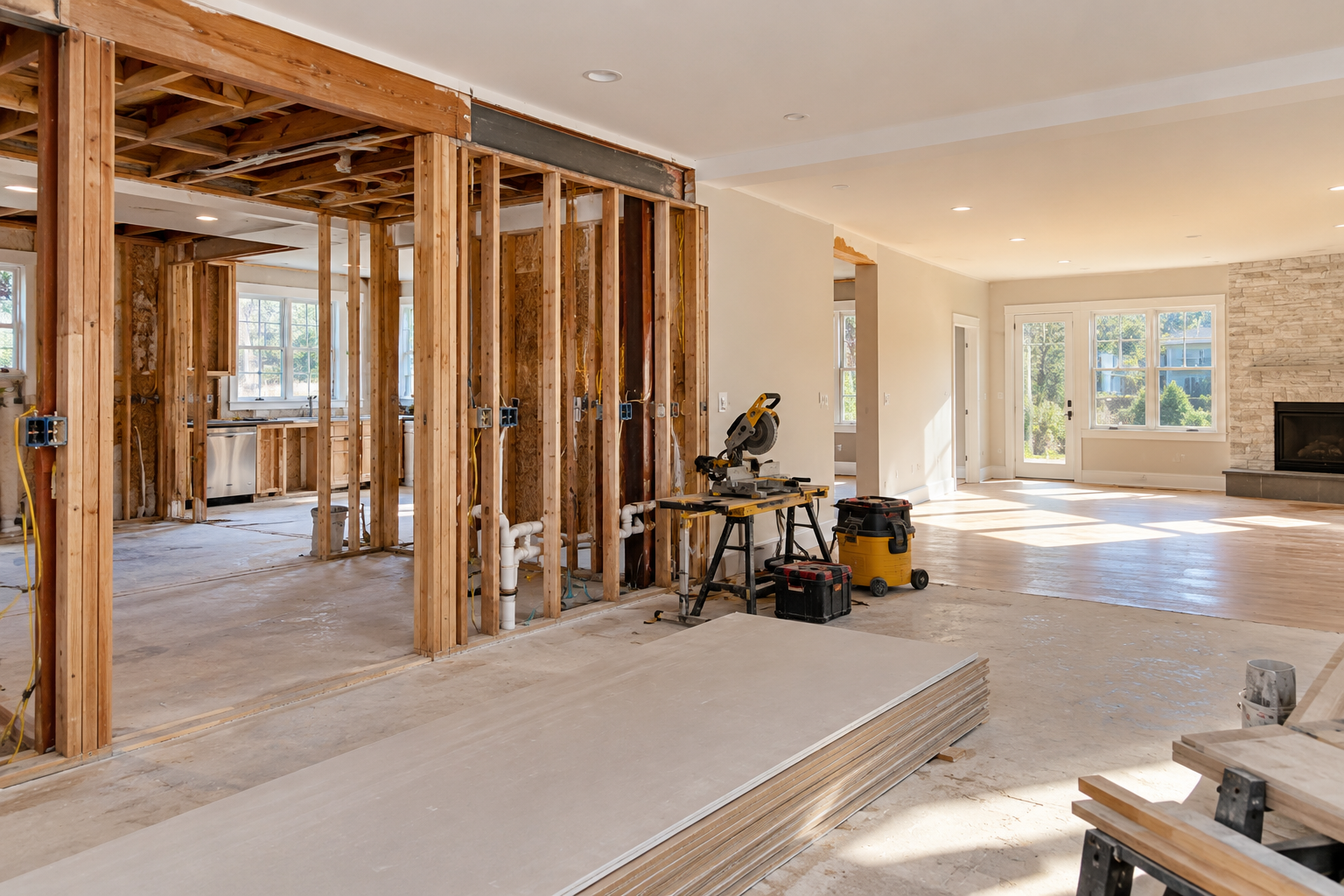
Full gut renovation. Everything stripped to studs. All systems — electrical, plumbing, HVAC — replaced. All layouts reconsidered. All finishes new. This scope is appropriate for homes that were last renovated more than 40 years ago, homes with significant deferred maintenance, or homes where the existing layout is so limiting that working within it would produce a renovated home that still doesn’t function well.
Whole home remodeling projects in Northern Virginia usually range from $175,000 to $500,000, depending on scope and square footage. Many homeowners budget on a per-square-foot basis, often falling between $150 and $300 per square foot for comprehensive renovations. However, for full gut renovations in premium DMV markets at high-end specification, a whole house remodel in Northern Virginia now typically costs between $350 and $700 per square foot. In a 2026 market where extensive projects frequently exceed $2 million, the line between a stunning success and a remodeling nightmare often comes down to the quality of planning.
Whole Home Remodel Cost by Scope — 2026 DMV Ranges
Multi-Room Cosmetic Refresh — $80,000 to $200,000
A cosmetic refresh across multiple rooms — kitchen cabinet fronts, countertops, bathroom vanities and tile, new flooring throughout, fresh paint — delivers a significant visual transformation without addressing structural or mechanical systems.
In Maryland’s premium markets, a thorough cosmetic refresh of a 2,000 to 2,500 square foot Colonial or Rambler runs $80,000 to $150,000. In Northern Virginia’s comparable markets, expect $90,000 to $200,000 depending on finish selection and the number of rooms included.
This scope is appropriate when the existing layout works well, when mechanical systems are in good condition, and when the primary goal is visual modernization before sale or for personal enjoyment of an otherwise functional home.
Comprehensive Renovation — $200,000 to $500,000
This is the most common whole-home renovation scope for DMV homeowners planning a meaningful, lasting transformation. A comprehensive renovation typically includes:
- Full kitchen gut renovation: $55,000 to $120,000
- Primary bathroom gut renovation: $45,000 to $85,000
- Secondary bathroom renovation: $20,000 to $40,000
- Main-level structural reconfiguration (wall removal, beam installation): $15,000 to $40,000
- Flooring replacement throughout: $20,000 to $50,000
- Electrical panel upgrade and partial rewiring: $12,000 to $25,000
- Plumbing updates (supply lines, fixtures throughout): $8,000 to $20,000
- HVAC updates or full replacement: $15,000 to $35,000
- Permits across all trade types: $3,000 to $12,000
Adding these components together, a comprehensive renovation of a 2,000 to 2,500 square foot Maryland or Northern Virginia home runs $200,000 to $400,000 at mid-range specification. At premium specification in Bethesda, McLean, or Potomac, comparable comprehensive renovations run $300,000 to $500,000.
If you’re planning a whole-home renovation in Northern Virginia or Montgomery County, Maryland in 2026, you’re renovating in two of the most design-driven, regulation-heavy, and quality-focused residential markets in the region. Homeowners in Arlington, McLean, Falls Church, and Vienna, as well as Bethesda, Chevy Chase, Potomac, and surrounding Montgomery County communities, are increasingly choosing to renovate rather than move.
Full Gut Renovation — $350,000 to $1,000,000+
A full gut renovation strips the home to its structural skeleton, replaces all systems, and rebuilds from the inside out. This scope is both the most expensive and the most transformative — delivering a home that is essentially new in every functional and finish element while retaining its location, lot, and structural bones.
Full gut renovations in Northern Virginia run $350 to $700 per square foot. For a 2,500 square foot home, this implies a range of $875,000 to $1,750,000 at comprehensive gut specification in a premium Northern Virginia market. In Maryland’s Montgomery County premium tier, comparable full gut renovations run $350 to $550 per square foot — slightly lower than Northern Virginia’s peak tier but still well above national averages.
This scope is appropriate for homes that haven’t been renovated since original construction in the 1960s or 1970s, homes with significant deferred maintenance in mechanical systems, or homes where the lot value has risen to the point where the land justifies a complete interior rebuilding.
Whole Home Remodel Cost Per Square Foot — The Honest DMV Reality
Per-square-foot pricing is the most commonly requested metric in whole-home renovation planning — and the most frequently misapplied. Here is the honest breakdown for the DMV in 2026.
| Scope Tier | Maryland Premium Markets | Northern Virginia Premium Markets | DC Metro |
|---|
| Cosmetic refresh | $40–$80/sq ft | $45–$90/sq ft | $50–$100/sq ft |
| Comprehensive renovation | $100–$200/sq ft | $120–$250/sq ft | $150–$300/sq ft |
| Full gut renovation | $200–$400/sq ft | $250–$500/sq ft | $300–$600/sq ft |
| Luxury full gut | $350–$550/sq ft | $400–$700/sq ft | $450–$750+/sq ft |
Maryland premium markets include Bethesda, Chevy Chase, Potomac, and upper Montgomery County. Northern Virginia premium markets include McLean, Great Falls, Arlington, and Alexandria. Ranges include labor, materials, permits, and contingency.
The critical caveat: These per-square-foot ranges apply to the renovated living area — not to the mechanical systems work, structural changes, or permit fees that don’t neatly translate to a per-square-foot metric. Furthermore, kitchen remodeling represents the largest single investment in most whole house renovations. In this market, the average kitchen costs approximately $75,000 — nearly 40% higher than the national average. Because kitchen renovation is disproportionately expensive per square foot compared to other rooms, homes with large kitchens or complex kitchen scopes will run toward the upper end of these ranges.
What Drives Whole Home Remodel Cost in the DMV — The Key Variables
Structural Work — The Hidden Multiplier
Structural changes are the single most significant cost variable that separates a cosmetic refresh from a genuine renovation. In Maryland and Northern Virginia’s 1960s–1990s housing stock, the most commonly requested structural change is removing the wall between the kitchen and family room to create an open-concept main level.
In homes with wood-framed bearing walls, this scope adds $8,000 to $20,000 for beam installation, temporary shoring, and structural repair. In homes with masonry bearing elements — common in older Maryland neighborhoods and DC rowhouses — this can add $15,000 to $40,000. Structural work also triggers permit requirements that add review time.
Mechanical System Condition — The Budget Wildcard
For DMV homes built before 1990, mechanical system condition is the most significant budget uncertainty in any comprehensive renovation. Common discoveries once walls are opened:
- Electrical panel below 200 amp capacity or without arc-fault protection: $8,000 to $15,000 to upgrade
- Galvanized water supply pipes: $6,000 to $18,000 to repipe
- Cast iron drain lines with corrosion or offset joints: $4,000 to $12,000 to reline or replace
- HVAC systems below current energy code efficiency requirements: $12,000 to $30,000 to replace
These are not surprises so much as expected discoveries. A 15 to 20% contingency above the construction estimate is the industry standard for any DMV home built before 1990 — and that contingency most commonly goes toward these mechanical realities.
Finish Specification Level
The specification level of finishes — cabinetry, countertops, tile, flooring, fixtures, and lighting — drives more cost variation within any scope tier than almost any other variable. In a comprehensive renovation:
Moving from semi-custom to fully custom cabinetry adds $15,000 to $40,000. Moving from quartz to natural stone countertops adds $5,000 to $15,000. Moving from ceramic tile to large-format natural stone adds $8,000 to $25,000 in the primary bathroom alone. These are legitimate specification choices with genuine aesthetic and durability implications — but they must be made with awareness of their cost impact on the total renovation budget.
Phasing Strategy — How DMV Homeowners Manage Large-Scale Renovation Budgets
Not every homeowner can or should undertake a comprehensive whole-home renovation at once. For homeowners whose budget supports phased renovation, here is the most effective phasing strategy for DMV homes.
Phase 1 — Kitchen and primary bathroom (simultaneous). These are the two highest-ROI renovation projects available in any DMV home — and the two rooms most frequently cited by buyers as the primary deciding factor at showings. Tackling them together reduces total disruption because both rooms require similar trade coordination (plumbing, electrical, tile setting) and similar permit submissions. Combined investment: $120,000 to $220,000.
Phase 2 — Secondary bathrooms and main-level structural work. Once the kitchen and primary bathroom are complete, secondary bathrooms and the main-level reconfiguration address the next tier of buyer-visible improvements. Combined investment: $50,000 to $120,000.
Phase 3 — Flooring, finishes, and mechanical upgrades. New flooring throughout, updated lighting, fresh paint, and mechanical system upgrades that weren’t addressed in Phases 1 or 2. Combined investment: $40,000 to $90,000.
This phased approach allows a homeowner to complete a comprehensive whole-home renovation for $210,000 to $430,000 over 2 to 3 years — at a pace that budget allows — rather than requiring the full investment simultaneously.
Whole Home Renovation ROI in the DMV
Understanding return on investment for comprehensive DMV renovation requires honest framing. Understanding which projects offer the best financial return helps prioritize spending. Here is the DMV-specific ROI picture:
Minor kitchen and cosmetic renovation ROI: 70 to 80% of cost returned at resale. These projects pay back well because they address the rooms buyers notice most while keeping investment proportionate to the home’s price tier.
Comprehensive renovation (kitchen, bathrooms, mechanical): 55 to 75% ROI at resale, with the higher end achieved when renovation specification matches the neighborhood price tier. A comprehensive renovation in Bethesda or McLean where the home’s value supports $500,000+ in renovation investment returns well. The same renovation dollar-for-dollar in a $400,000 home in a lower-priced neighborhood does not.
Full gut renovation: 50 to 65% ROI at resale on the renovation investment itself — but the calculation changes dramatically when the alternative is moving. In a market where selling and buying a comparable home costs $75,000 to $150,000 in transaction costs and rate differences, a full gut renovation that recovers 60% of $500,000 still produces a better net financial outcome than the alternative for most homeowners.
In a $1.5 million McLean home, a dated kitchen may prevent the sale entirely or force price reductions exceeding renovation costs. For luxury properties, major remodels preserve the asset’s marketability.
H&C Construction Whole Home Renovation Across the DMV
H&C Construction Design Build plans and builds comprehensive whole-home renovations across Maryland, Washington DC, and Northern Virginia — including Bethesda, Rockville, Potomac, Silver Spring, Chevy Chase, Montgomery County, Arlington, Alexandria, McLean, Fairfax County, and all DC neighborhoods.
Our design-build model — design, permitting, and construction under one accountable team — is specifically suited to whole-home renovation because the complexity of coordinating multiple trades, multiple permit types, and multiple finish specifications across every room simultaneously requires integrated management. Browse completed whole-home and multi-room renovation projects in our Our Remodeling Projects portfolio.
Ready to Plan Your Whole Home Renovation?
Whether you’re planning a targeted multi-room refresh, a comprehensive renovation across all major spaces, or a full gut transformation, our design-build team will give you an honest, scope-specific cost range for your home — before any commitment.
As Licensed Contractors in Maryland with active Virginia DPOR credentials and DC project experience, we manage all whole-home renovation permit applications across every DMV jurisdiction.
Request a consultation to get a realistic 2026 whole home remodel estimate today.