Remodel or Move? Why Most Maryland and Northern Virginia Homeowners Are Choosing to Stay in 2026
At some point, almost every homeowner in Bethesda, Rockville, Potomac, or Fairfax has the same conversation. The house feels too small, or the layout no longer fits the family, or the kitchen needs to be completely different. The question that follows is almost always the same: should we remodel, or should we move?
In 2026, that question has a clearer answer than it has in years. Most homeowners — when they run the full math — are choosing to stay. Because of a combination of market forces specific to Maryland and Northern Virginia, remodeling has become the financially and logistically superior option for the large majority of DMV households.
This isn’t sentiment. It’s numbers. Here’s why.
The Real Cost of Moving in the DMV in 2026
Moving sounds simpler than a renovation. In reality, it is among the most expensive financial transactions most homeowners make — and the costs are front-loaded, often invisible until closing day.
Agent commissions. Selling a home in Maryland or Northern Virginia typically costs 5% to 6% of the sale price in realtor commissions. On a $700,000 home, that’s $35,000 to $42,000 — gone before you’ve purchased a single square foot of new space.
Transfer taxes and closing costs. Maryland imposes transfer and recordation taxes on both buyer and seller. In Montgomery County specifically, these add meaningfully to the total transaction cost. Closing costs on the new home purchase typically run an additional 2% to 5% of the purchase price.
The mortgage rate problem. This is the most significant factor in 2026. More than 80% of Maryland homeowners with mortgages currently hold interest rates below 6%, with many locked in at 3% to 4% during 2020 and 2021. Selling that home and buying another means giving up that rate permanently. For a homeowner carrying a $400,000 mortgage balance, the monthly payment difference between a 3% and a 6.5% rate on a comparable home can exceed $800 to $900 per month — more than $10,000 per year, every year, indefinitely. This is what housing economists call the “lock-in effect,” and it is keeping hundreds of thousands of homeowners in place across the DMV.
The cost of the move itself. Professional moving costs, temporary storage, replacing furniture that doesn’t fit the new space, and the disruption to daily routines add thousands more to the total transaction before you’ve even begun to address whatever deficiencies the new home has.
Add these together. The true cost of moving for a typical Maryland or Northern Virginia homeowner in 2026 — before buying anything at all — commonly reaches $80,000 to $120,000 or more in transaction friction, lost rate advantages, and associated expenses. Against that number, a thoughtfully planned remodeling project begins to look very different financially.
The Market Reality in Maryland and Northern Virginia
The housing market picture in 2026 adds additional weight to the stay-and-remodel case.
Inventory remains constrained. While active listings have grown modestly across the Mid-Atlantic compared to 2024, the supply of move-in-ready, spacious homes in desirable Montgomery County, Fairfax County, and Northern Virginia neighborhoods remains well below historical norms. In other words, the home you’d want to move into may not exist at a price that makes the move worthwhile — especially when transaction costs are factored in.
Home values in the DMV are holding. Housing economists project modest appreciation of 2% to 4% annually across Maryland in 2026. Because of this, the equity you’ve built in your existing home continues to compound. Investing that equity in a thoughtful remodel — rather than surrendering a significant portion of it to transaction costs — directly adds to that asset’s value rather than depleting it.
Buyers are choosing remodeling over moving at historic rates. Survey data from Redfin shows that 71% of homeowners planning to renovate in the next year say they’re remodeling instead of buying a new home. Nationally, homeowners are staying in their homes for roughly twelve years on average — more than double the historical rate — and investing in the homes they already own.
What You Can Build Instead of Moving
Here’s where the conversation shifts from defensive to genuinely exciting. Because rather than asking what you’re giving up by not moving, the better question is what you can actually create by staying.
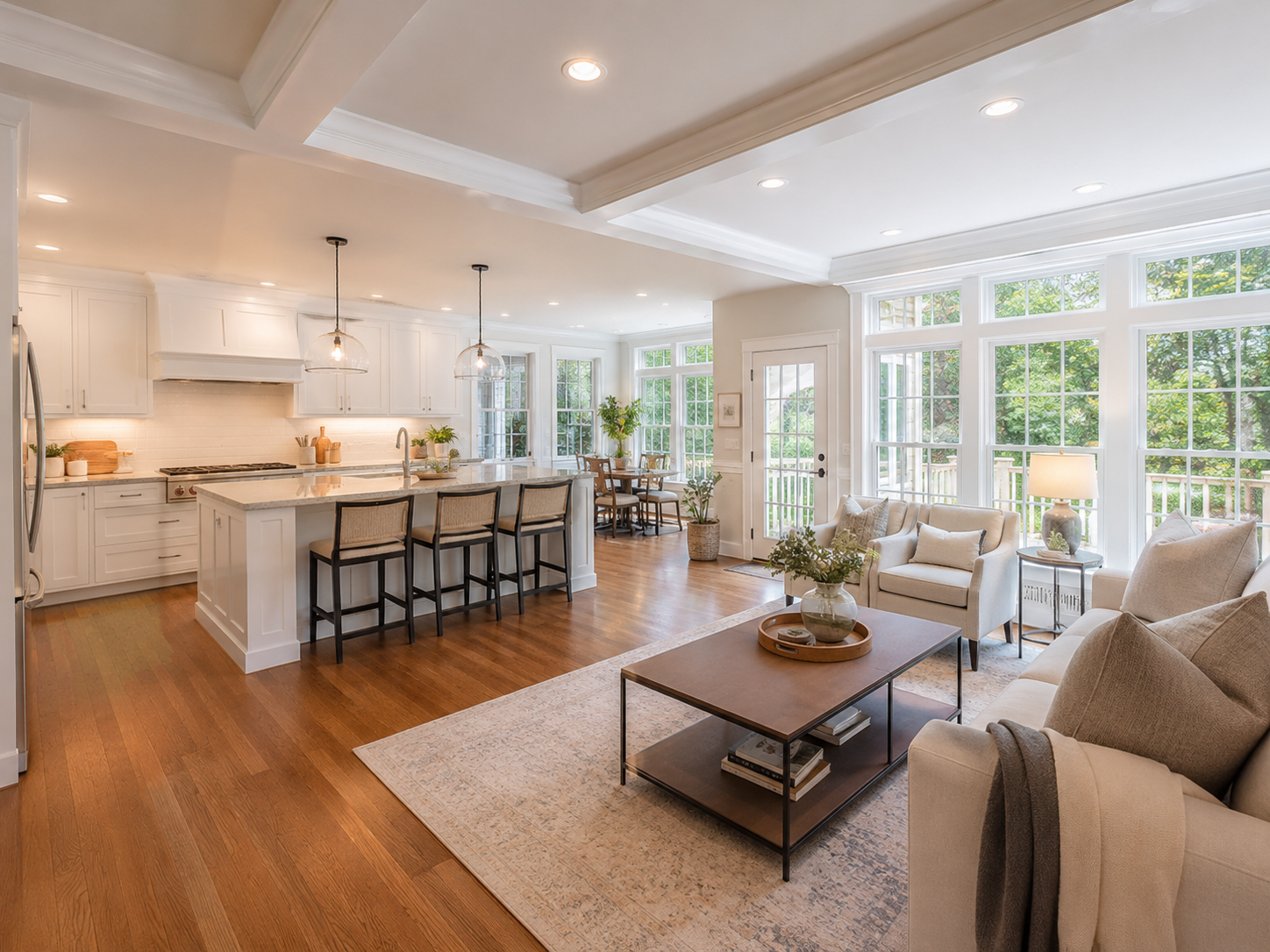
An open-concept kitchen you’ve always wanted. Rather than hoping the next house happens to have the kitchen layout you’re picturing, a Kitchen Remodeling project builds it specifically for how your family cooks, gathers, and lives.
A primary bathroom that functions as a genuine retreat. A Bathroom Remodeling project delivers the spa-style layout, the heated floors, and the curbless shower that speculative house-hunting rarely produces.
More bedrooms without changing your address. A Basement Remodeling project adds legal bedroom and living space below. A Home Additions project adds it above or beside. Both keep you in your neighborhood, your school district, and your community.
A whole-home transformation. For homeowners whose frustrations span multiple rooms, a coordinated Full Home Remodeling project addresses the full scope under one plan — eliminating the piecemeal disruption of tackling rooms one at a time over years.
The ROI Argument: When Remodeling Also Makes Financial Sense
For homeowners considering resale within the next three to seven years, the ROI picture for strategic remodeling in the DMV is compelling.
Kitchen remodeling in Maryland and Virginia consistently returns 70% to 80% of project cost in increased home value, according to regional remodeling data. Bathroom remodeling returns 60% to 70%. Well-designed deck additions return upwards of 83%. Crucially, these returns come on top of the equity already held in the home — and on top of the $80,000 to $120,000 in transaction costs that were avoided by not moving.
The math is not complicated. For many DMV homeowners, remodeling is simply the better financial decision — even before considering the lifestyle value of getting exactly the home you want rather than the best available compromise on the market.
When Moving Is Still the Right Answer
In the interest of a complete and honest picture: there are situations where moving is the right call.
Your location no longer fits your life. If you need to be in a different school district, closer to a new job, or in a different part of the DMV entirely, no renovation can solve a location problem.
Your lot is the limitation. If your primary need is more land, more outdoor space, or a fundamentally different setting, an addition can add interior space but cannot change what’s outside the property line.
The home’s bones are fundamentally wrong. Some homes have layouts, orientations, or structural realities that make renovation prohibitively expensive relative to moving. This is worth assessing honestly — a professional design consultation helps clarify this before you commit.
You have no remaining rate advantage. If you purchased recently at a market rate, the mortgage rate lock-in argument doesn’t apply with the same force.
How to Think About This Decision Clearly
Before making either choice, a few questions help clarify the right path.
Is your frustration with the house, or with the location? These are genuinely different problems. A renovation can solve the house. It can’t solve the location.
Have you run the full cost of moving? Most homeowners underestimate total transaction costs. Running the real number — including the rate differential over the expected years of ownership — often shifts the calculation decisively.
What would you actually build? The most useful step is usually a professional consultation with a design-build contractor to understand what’s realistically possible in your current home and at what cost. That conversation replaces speculation with actual data.
The H&C Construction Approach
At H&C Construction Design Build, we’ve helped homeowners across Maryland, Washington DC, and Northern Virginia work through exactly this decision. We bring honest, professional perspective — not a sales pitch — to what is usually one of the biggest financial and lifestyle decisions a household makes.
We are Licensed Contractors in Maryland with deep experience across Montgomery County, Fairfax County, and the entire DMV. Our design-build model handles every phase — design, permitting, and construction — under one accountable team.
Browse completed projects across Maryland, DC, and Virginia in our Our Remodeling Projects portfolio. Then request a consultation — and let’s have an honest conversation about what your home can become.
The Bottom Line for Maryland and Northern Virginia Homeowners
Moving costs more than most people realize. The homes available to move into are fewer and more expensive than most expect. And the rate you’re protecting by staying is worth far more than most people calculate.
In addition, remodeling gives you something moving rarely delivers: a home built precisely for your family — in the neighborhood you chose, near the schools and community you value, without starting over.
That’s why most Maryland and Northern Virginia homeowners are choosing to stay. And it’s why this is the right moment to have a serious conversation about what staying could look like for you.
Ready to Make Your Home Work for Your Life?
H&C Construction Design Build serves homeowners across Maryland, Washington DC, and Northern Virginia — including Rockville, Bethesda, Potomac, Silver Spring, Chevy Chase, Gaithersburg, Montgomery County, Arlington, Alexandria, and Fairfax. Whether you’re planning a single-room upgrade or a full home transformation, our licensed design-build team is ready to help.
Explore our Full Home Remodeling service and request a consultation to start the conversation.