Home Renovation in Petworth, Columbia Heights, Adams Morgan, and Shaw: What DC Homeowners in the District’s Rising Neighborhoods Need to Know in 2026
Something significant is happening across the neighborhoods north and east of downtown Washington DC. Petworth, Columbia Heights, Adams Morgan, Shaw, Bloomingdale, U Street, and surrounding communities are in the middle of a renovation investment wave that reflects both the appreciation these neighborhoods have experienced and the genuine character of the housing stock that residents have chosen to invest in.
These are not the historic preservation-heavy renovation markets of Georgetown and Capitol Hill, where the Old Georgetown Board or the most intensive HPRB scrutiny governs every exterior decision. However, they carry their own distinct character, regulatory considerations, and renovation realities that differ meaningfully from suburban Maryland or Northern Virginia. Because of this, DC homeowners in these neighborhoods deserve a contractor who understands exactly what their specific address involves — not one applying a generic renovation playbook from a different market.
At H&C Construction Design Build, we serve homeowners throughout Washington DC’s neighborhoods, including Petworth, Columbia Heights, Adams Morgan, Shaw, Bloomingdale, U Street, Congress Heights, and all surrounding communities. Here’s what you need to know before starting a renovation in 2026.
Understanding DC’s Rising Neighborhoods — What They Share and How They Differ
These neighborhoods share certain characteristics. They are primarily composed of pre-World War II rowhouse stock — brick masonry construction from roughly 1890 to 1940 — that has aged through different levels of maintenance and update over the past 80 to 130 years. They are in various stages of a generational investment cycle, where homeowners who purchased at lower price points are now making substantial renovation investments to bring their homes to the standards their appreciation has unlocked. And they share the same DC permitting environment — the DC Department of Buildings, DC’s building codes, and in some cases DC’s Historic Preservation Office.
However, each neighborhood also has a distinct character that shapes renovation decisions.
Petworth
Petworth is one of DC’s most active renovation neighborhoods in 2026. Its rowhouses — primarily semi-detached two-story brick homes with front porches from the 1920s and 1930s — are spacious by DC standards, often with more generous lot sizes than Capitol Hill or Georgetown. Because of this, Petworth has become one of the most popular neighborhoods for homeowners planning substantial full gut renovations, including basement underpinning to gain ceiling height, main-level reconfiguration, and kitchen extensions into rear yard space.
In Petworth, the Washington DC Department of Buildings processes permits. Adams Morgan and surrounding neighborhoods like Petworth sit in R-3 zoning areas and require compliance with HPO permits for any exterior changes in designated historic areas. However, large portions of Petworth’s rowhouse stock are not individually listed or in a formal historic district. Confirming the historic status of your specific property before planning any exterior work is an essential first step. Long Home
Columbia Heights
Columbia Heights is one of DC’s most diverse and densely populated neighborhoods — and one of its most renovation-active. Its rowhouses range from narrow two-story Colonials to larger three-story structures, with significant condominium and apartment building stock alongside single-family and rowhouse properties. For homeowners planning renovations in Columbia Heights, the R-3 zoning classification and proximity to several historic overlay districts means exterior changes require case-by-case historic status confirmation before design proceeds.
Full gut renovations in Columbia Heights — removing everything to the studs, replacing all systems, opening the main level, and rebuilding to current standard — are increasingly common as homeowners who purchased during earlier investment cycles fund comprehensive updates. These projects are exactly what H&C’s Full Home Remodeling service was built to deliver.
Adams Morgan
Adams Morgan is one of DC’s most internationally recognized neighborhoods — a dense, vibrant urban community built primarily around early 20th century rowhouses and apartment buildings on and around 18th Street NW. Adams Morgan specializes in historic rowhouse renovations and faces local challenges including tight spaces and R-3 zoning restrictions, ensuring compliance with HPO permits. Long Home
Renovation in Adams Morgan requires acute awareness of these constraints. Tight work spaces and dense street conditions require careful material delivery and waste management planning. However, the neighborhood’s architectural character — its rowhouses retain genuine early-century urban design integrity — rewards renovations that honor that character rather than imposing a contemporary aesthetic that feels out of place.
Shaw and U Street
Shaw and the U Street Corridor represent some of DC’s most historically significant African American cultural heritage — and some of its most appreciated real estate. The neighborhood’s Victorian-era rowhouses, many dating to the 1890s and early 1900s, carry genuine architectural value. Many Shaw properties fall within the Greater U Street Historic District, which means exterior changes require DC HPO review.
However, the renovation opportunity in Shaw is substantial precisely because the neighborhood’s appreciation has unlocked investment capacity that earlier owners often didn’t have. Full gut renovations — opening compartmentalized Victorian layouts, adding spa-quality bathrooms, and bringing aging mechanical systems to current code — are among the most actively pursued project types in Shaw in 2026.
Bloomingdale, Anacostia, and Congress Heights
Bloomingdale, adjacent to Shaw and Ledroit Park, features some of DC’s most intact early-20th-century rowhouse blocks. Like Shaw, exterior changes in designated historic areas require HPO coordination.
Further east and south, neighborhoods like Anacostia and Congress Heights — where Taylor Cloud’s full gut renovation project is located — represent the newest wave of serious renovation investment in DC. These neighborhoods have substantial, well-built rowhouse stock that has been underinvested for decades. As investment reaches these communities, the renovation opportunity is real, the housing stock is structurally sound, and the project scopes are comprehensive. Full gut renovations in these neighborhoods — structural, two new bathrooms, kitchen, mechanical, flooring, and exterior — are exactly the type of work H&C’s design-build team is built to execute.
The DC Renovation Realities That Apply Across All These Neighborhoods
Regardless of which of these neighborhoods your home sits in, several regulatory and structural realities apply across virtually all of DC’s pre-war rowhouse stock.
Lead paint is presumed in every pre-1978 property. This includes the vast majority of the housing stock in all of these neighborhoods. Federal EPA regulations require that all contractors working in pre-1978 homes hold EPA Lead RRP certification and follow required containment and disposal protocols. Our team holds all required certifications and applies these protocols on every DC renovation project.
The DC Department of Buildings permit process applies to all structural, electrical, plumbing, and mechanical work. There are no shortcuts. Renovation work in these neighborhoods involving any of these trade types requires permits through DC DOB’s Permit Wizard or ProjectDox system. Standard residential renovation permits typically take 4 to 8 weeks from complete application to issuance.
Historic status must be confirmed for your specific property before exterior work is designed. Not every property in these neighborhoods is in a formal historic district. However, many are — and the line between individually designated properties, contributing resources in historic districts, and unprotected properties is not obvious from street-level observation. A contractor who assumes exterior work requires no historic review without confirming it for your specific address is creating risk.
Older rowhouse systems require assessment before renovation begins. Knob-and-tube wiring, cloth-wrapped electrical cables, galvanized water supply pipes, cast iron drain lines, and inadequate insulation are common findings in the pre-war rowhouse stock across all of these neighborhoods. A 15 to 20% contingency above the renovation estimate is standard professional planning for any DC project in a home built before 1950.
What Full Renovation Scopes Look Like in These Neighborhoods
The renovation projects H&C’s team completes across DC’s rising neighborhoods often involve comprehensive, multi-system scopes that go well beyond cosmetic updates. Here’s what typical full renovation projects include in these housing types.
Structural work. Removing load-bearing walls to open the main level requires steel beam installation, properly engineered and inspected before any finish work covers the structure. In DC’s masonry rowhouses, this work also involves coordination with party wall structural assessment.
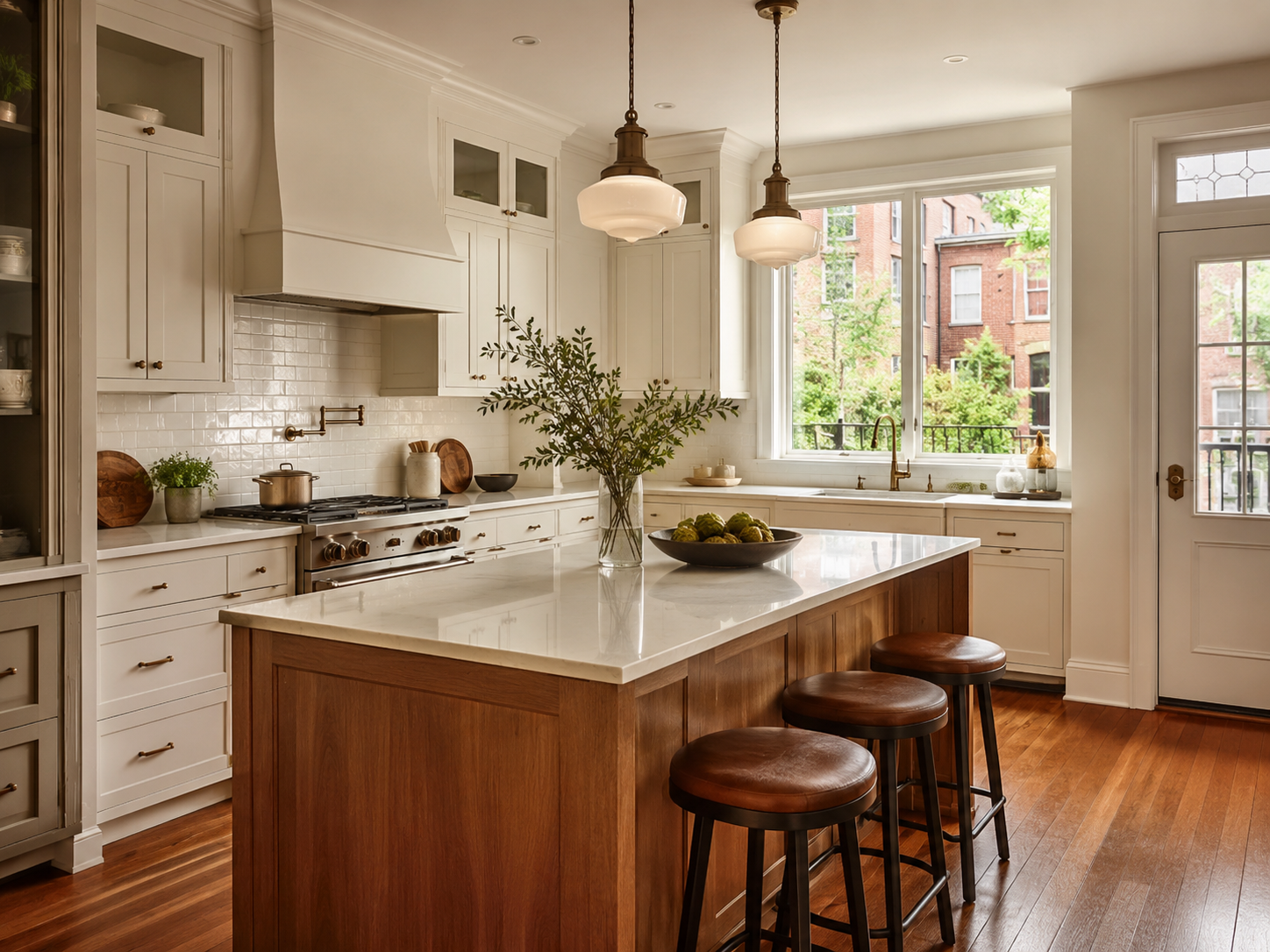
Kitchen renovation. Full gut replacement — new cabinetry, countertops, appliances, updated plumbing and electrical — coordinated with whatever layout reconfiguration is part of the scope. Minor cosmetic kitchen refreshes in DC typically run $40,000 to $60,000. Mid-range full renovations run $75,000 to $120,000. High-end custom kitchens in DC neighborhoods can exceed $200,000.
Bathroom renovation and addition. Many older DC rowhouses have only one or one-and-a-half bathrooms. A common renovation goal is adding a second full bathroom — sometimes through basement conversion, sometimes through reconfiguration of existing upper-floor space — while also fully renovating the existing bathroom.
Mechanical system replacement. Electrical panel upgrades, plumbing repiping, and HVAC updates are common components of full gut renovations in these neighborhoods. Because renovation work opens walls and floors, coordinating system replacement during the renovation window is both the most efficient and least disruptive approach.
Basement underpinning or finishing. Many DC rowhouses have below-grade basements with low ceiling heights. Underpinning — carefully excavating beneath the existing foundation footings to lower the basement slab — can transform an unusable crawl space into a habitable lower level. Our Basement Remodeling and Restoration & Rebuild teams handle underpinning and basement finishing projects across these neighborhoods.
Exterior work. Rear patio renovation, window replacement, exterior door replacement, and sometimes rear additions — all coordinated through DC DOB permitting and, where applicable, DC HPO review.
Renovation Cost Ranges for DC’s Rising Neighborhoods in 2026
Renovation costs in Petworth, Columbia Heights, Adams Morgan, and Shaw reflect DC’s premium labor market and the comprehensive scopes that older rowhouse stock typically requires.
Targeted interior renovation (kitchen or bathroom only): $50,000 to $120,000 depending on scope, layout changes, and finish specification.
Full gut renovation of primary living levels (no addition): $150,000 to $350,000 for a comprehensive renovation across all interior levels — structural, mechanical, kitchen, bathrooms, flooring, and finish work throughout.
Full gut renovation with rear addition or basement underpinning: $250,000 to $500,000+ depending on the scope of structural expansion, addition size, and finish level.
Contingency: 15 to 20% above the construction estimate. Older DC rowhouses consistently reveal deferred maintenance and out-of-code conditions once demolition begins. Budgeting for this honestly from the start is accurate planning.
H&C Construction in DC’s Rising Neighborhoods
H&C Construction Design Build serves homeowners throughout Washington DC — including Petworth, Columbia Heights, Adams Morgan, Shaw, Bloomingdale, U Street, Congress Heights, Anacostia, and all DC neighborhoods. Our design-build model coordinates design, historic preservation coordination where required, DC DOB permitting, and construction under one accountable team.
We understand the structural realities of DC’s pre-war rowhouse stock, hold all required EPA Lead RRP certifications, manage DC DOB permit applications, and coordinate HPO review as an integrated part of every DC project where exterior changes are involved.
Browse completed renovation projects across DC and the broader DMV in our Our Remodeling Projects portfolio.
Ready to Plan Your DC Renovation?
Whether you’re planning a kitchen transformation, a full gut renovation, a bathroom addition, or a basement underpinning project in Petworth, Columbia Heights, Adams Morgan, Shaw, or anywhere across Washington DC, our design-build team is ready to give you an honest assessment and a realistic plan.
Request a consultation to start the conversation today.