
Why 2026 Homeowners Are Upgrading Windows, Insulation, Flooring, and Layouts for Summer Comfort
Energy-efficient home remodeling in Maryland is becoming one of the most important priorities for homeowners in 2026. As summer approaches, families across Rockville, Bethesda, Potomac, Silver Spring, Chevy Chase, Gaithersburg, Washington, D.C., Arlington, and Northern Virginia are thinking beyond cosmetic upgrades.
They are asking a more strategic question:
How can our home stay cooler, feel more comfortable, waste less energy, and perform better during the summer?
That question is at the center of modern energy-efficient remodeling.
A home does not become efficient because of one upgrade alone. New windows help, but only if air leaks, insulation, layout, ventilation, materials, and indoor comfort are also considered. Better flooring can improve durability and comfort, but it should be matched to the right room. A kitchen remodel can improve airflow and lighting, but it should also support practical daily use. A full-home remodel can align all of these decisions into one smarter plan.
The U.S. Department of Energy explains that insulation and air sealing help keep homes cool in summer and warm in winter, and that increasing insulation is one of the fastest and most cost-effective ways to reduce energy waste. ENERGY STAR also estimates that homeowners can save an average of 15% on heating and cooling costs by air sealing and adding insulation in key areas such as attics, basements, crawl spaces, and floors.
At H&C Construction Design Build, we help Maryland and DMV homeowners remodel with comfort, durability, craftsmanship, and long-term value in mind. If your home feels too hot in summer, drafty in certain rooms, poorly insulated, outdated, or inefficient, this may be the right time to explore Full Home Remodeling or view Our Remodeling Projects.
Why Energy-Efficient Remodeling Matters in 2026
Energy-efficient remodeling is not just about lowering utility bills. It is about improving the way the home feels every day.
Many older Maryland homes were not designed for today’s comfort expectations. Some have outdated windows, weak attic insulation, poor air sealing, aging flooring, inefficient layouts, limited natural light, and spaces that feel too hot in summer or too cold in winter.
That creates common homeowner frustrations:
- Upstairs rooms feel hotter than the rest of the home
- Basements feel damp or musty
- Windows allow heat gain or drafts
- Kitchens feel uncomfortable during cooking
- Bathrooms hold humidity
- Flooring feels worn, uneven, or poorly suited to the room
- Additions or enclosed porches feel disconnected from the HVAC strategy
- Energy bills rise without a clear explanation
- The home feels less comfortable than it should
Energy-efficient remodeling solves these issues by improving the home as a system.
That is why many homeowners are moving from single-room cosmetic projects to more strategic upgrades through Full Home Remodeling. A professional remodel can improve layout, materials, insulation opportunities, ventilation, lighting, and comfort together instead of treating each room as an isolated project.
Windows: One of the Most Visible Energy-Efficiency Upgrades
Windows affect comfort, natural light, curb appeal, and energy performance.
Older or poorly installed windows can allow unwanted heat gain during summer and drafts during colder months. They can also make certain rooms uncomfortable, especially spaces with direct sun exposure or poor shading.
Energy-efficient windows can help improve:
- Indoor comfort
- Summer cooling performance
- Draft reduction
- Natural light quality
- Noise control
- Curb appeal
- Resale perception
- Moisture and condensation control when properly selected and installed
The Department of Energy’s Energy Saver guidance explains that homeowners should choose efficient products and proper installation because windows, doors, and skylights can affect heating, cooling, and comfort. Energy-efficient windows designed for the right climate can help reduce heating and cooling costs and improve year-round comfort.
For Maryland homeowners, the key is not only replacing glass. The installation must be handled correctly. Poor flashing, weak sealing, or incorrect integration with siding and trim can create future water intrusion or air leakage.
That is why window-related remodeling should be coordinated with an experienced General Contractor in Maryland or Licensed Contractors in Maryland, especially when the project connects to siding, trim, insulation, interior drywall, or larger exterior work.
Insulation and Air Sealing: The Hidden Upgrade That Changes Comfort
Some of the most important energy-efficient remodeling work happens behind the walls, above the ceiling, and below the floor.
Insulation and air sealing are not always visible in final project photos, but they can dramatically affect comfort.
The Department of Energy recommends adding insulation in attics, crawl spaces, basements, and exterior walls together with air sealing to help keep the house cooler in summer and warmer in winter. ENERGY STAR similarly emphasizes that sealing air leaks and adding insulation can reduce heating and cooling costs and improve comfort.
Common areas where homes lose comfort include:
- Attics
- Crawl spaces
- Basements
- Rim joists
- Exterior walls
- Around windows and doors
- Around plumbing penetrations
- Around electrical penetrations
- Around recessed lighting
- Around ductwork
- Around additions or older remodels
For homeowners planning Basement Remodeling, insulation and air sealing are especially important. A finished basement should not only look complete. It should feel dry, comfortable, and properly separated from moisture and temperature swings.
For homeowners planning Home Additions, insulation and air sealing are also critical because new construction must connect correctly to the existing home. Poorly integrated additions can create comfort problems, air leaks, moisture issues, and uneven temperatures.
Flooring Choices Can Improve Comfort and Durability
Flooring is often treated as a design decision, but it also affects comfort, efficiency, durability, and maintenance.
In summer, flooring can influence how cool or warm a room feels underfoot. In basements, bathrooms, kitchens, mudrooms, and walkout areas, flooring also needs to perform under moisture, humidity, and heavy use.
Energy-conscious flooring decisions should consider:
- Room location
- Moisture exposure
- Durability
- Cleaning requirements
- Comfort underfoot
- Subfloor condition
- Insulation below the floor
- Slip resistance
- Heat gain and cooling feel
- Long-term maintenance
Good flooring choices may include tile, luxury vinyl plank, engineered flooring rated for the right conditions, and other durable materials depending on the room.
For example, a basement may need moisture-conscious flooring. A kitchen may need durable flooring that handles spills and heavy traffic. A bathroom may need slip-resistant flooring with proper waterproofing. A sun-exposed room may need materials that hold up well over time.
This is why flooring decisions should be connected to the broader remodel. During Full Home Remodeling, homeowners can coordinate flooring transitions, insulation needs, room function, and design consistency across the property.
If old flooring has been damaged by water, humidity, or poor previous installation, homeowners may also need Restoration & Rebuild before installing new finishes.
Layouts Affect Summer Comfort More Than Homeowners Realize
A home’s layout can either support comfort or work against it.
Closed-off rooms may trap heat. Poorly placed doors can block airflow. Kitchens may overheat during cooking. Additions may feel disconnected from the rest of the home. Basements may feel isolated or damp. Living areas may lack natural light or cross-ventilation.
Energy-efficient remodeling should consider how people, air, light, and heat move through the home.
Layout improvements may include:
- Opening selected walls
- Improving kitchen-to-living flow
- Adding larger doorways
- Improving access to outdoor spaces
- Creating better basement circulation
- Reworking awkward additions
- Improving natural light
- Creating better room zoning
- Planning shaded exterior transitions
- Improving storage to reduce clutter and airflow blockage
A better layout can make the home feel cooler, brighter, and more functional.
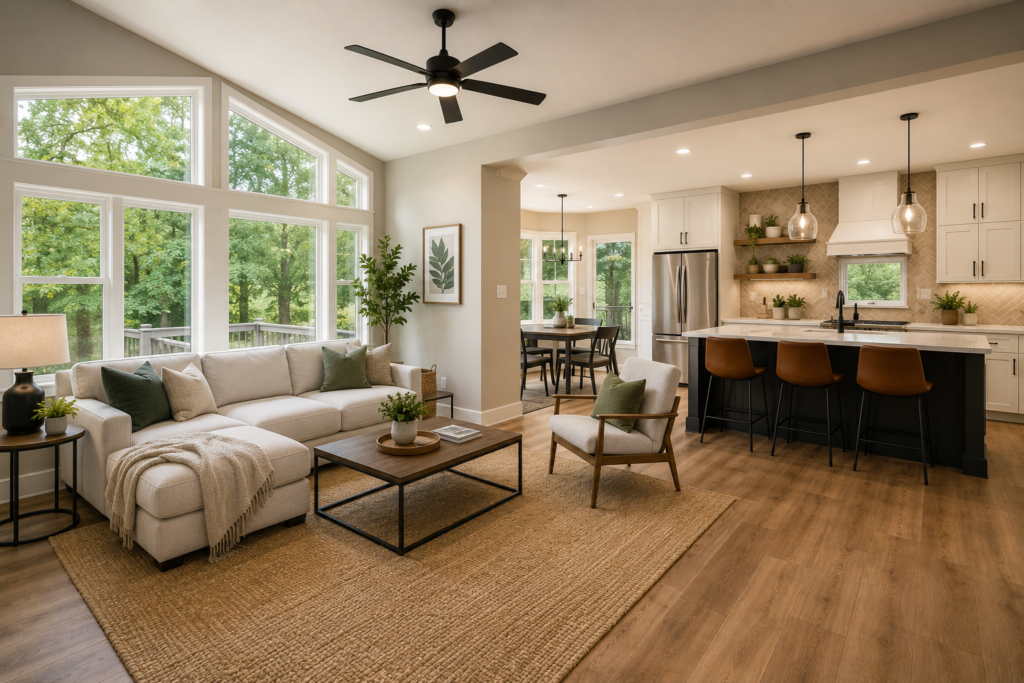
For example, a kitchen that opens toward a dining area and shaded outdoor space can support better entertaining and summer comfort. A basement with better lighting and circulation can become usable living space instead of a dark storage area. A home addition with proper planning can feel integrated instead of overheated or disconnected.
This is why layout work often connects with Kitchen Remodeling, Basement Remodeling, Home Additions, and Full Home Remodeling.
Kitchen Remodeling Can Support Efficiency and Comfort
The kitchen is one of the most important rooms for energy-efficient remodeling because it combines lighting, appliances, ventilation, plumbing, heat, cabinetry, flooring, and daily activity.
A kitchen that is poorly designed can feel hot, crowded, and inefficient. A better kitchen remodel can improve function and comfort at the same time.
Energy-conscious kitchen remodeling may include:
- Better ventilation
- Efficient lighting
- Smarter appliance placement
- Durable flooring
- Improved natural light
- Better exterior door placement
- Indoor-outdoor dining connection
- More efficient storage
- Reduced clutter
- Better traffic flow
- Heat-resistant and durable surfaces
A kitchen remodel can also improve summer living when it connects better to a deck, porch, or outdoor dining area. Instead of trapping family activity inside, the kitchen can become part of a more comfortable indoor-outdoor lifestyle.
This is where Kitchen Remodeling connects naturally with Decks & Porches. A better kitchen-to-deck connection can improve entertaining, natural light, and summer comfort.
For homeowners planning a broader upgrade, the kitchen should be part of the larger energy-efficient remodeling strategy, not a separate design island.
Bathroom Remodeling Helps Control Moisture and Humidity
Bathrooms are another key part of energy-efficient home remodeling because they affect moisture, ventilation, indoor air quality, and material durability.
A bathroom with poor ventilation can hold humidity, create condensation, damage finishes, and contribute to mold risk. In summer, humidity problems can feel even worse.
A moisture-smart bathroom remodel may include:
- Proper exhaust ventilation
- Waterproof shower systems
- Durable tile installation
- Moisture-resistant materials where appropriate
- Better lighting
- Slip-resistant flooring
- Efficient fixtures
- Improved layout
- Better storage
- Proper sealing around wet areas
This is why Bathroom Remodeling should be planned around performance, not only appearance.
A beautiful bathroom that is not properly ventilated or waterproofed may fail over time. A well-built bathroom can improve comfort, durability, and daily function.
For homeowners with older bathrooms, moisture damage, or outdated construction, bathroom remodeling may also connect with Restoration & Rebuild before final finishes are installed.
Basements Need a Special Energy-Efficient Remodeling Strategy
Basements require a different remodeling strategy because they are partly or fully below grade.
That means comfort depends on moisture control, insulation, ventilation, lighting, flooring, and proper material selection.
A good basement remodel should address:
- Moisture signs
- Foundation wall condition
- Humidity
- Insulation
- Air sealing
- Window quality
- Flooring compatibility
- Lighting
- Ventilation
- Storage
- Mechanical areas
- Safe egress when needed
Basements can be cooler in summer, but they can also feel damp, musty, or uncomfortable if moisture and air movement are not addressed.
A high-quality Basement Remodeling project can turn the lower level into a comfortable living space, guest suite, office, entertainment room, or family area. But the project should begin with performance, not decoration.
If the basement has signs of water intrusion or mold risk, homeowners should consider Restoration & Rebuild before finishing the space.
Outdoor Shade and Porches Can Reduce Summer Heat Stress
Energy-efficient remodeling is not only about the inside of the home. Exterior design can also improve summer comfort.
Covered porches, decks, pergolas, shade structures, and outdoor rooms can help homeowners use their property more comfortably during warm months. They can also reduce direct sun exposure near doors, windows, and living areas.
Outdoor comfort upgrades may include:
- Covered porches
- Pergolas
- Screened porches
- Shaded decks
- Outdoor ceiling fans
- Strategic landscaping
- Privacy screens
- Outdoor dining areas
- Better transitions from kitchen to exterior spaces
- Durable decking materials
A well-designed Decks & Porches project can make the home feel larger and more usable in summer.
For homeowners who want a complete comfort strategy, outdoor living should connect with indoor layout planning. A shaded porch outside the kitchen or living room can improve daily life and make summer entertaining easier.
Home Additions Must Be Designed for Comfort From the Start
A home addition can solve space problems, but only if it is designed correctly.
Poorly planned additions can become too hot, too cold, poorly ventilated, or disconnected from the original home. A strong addition should be integrated into the home’s structure, layout, insulation strategy, exterior envelope, window placement, and mechanical planning.
Energy-conscious addition planning should consider:
- Window placement
- Solar heat gain
- Insulation
- Air sealing
- Roofline integration
- Exterior materials
- Flooring transitions
- HVAC coordination
- Natural light
- Shade
- Ventilation
- Moisture control
- Interior flow
This is why Home Additions should not be treated only as extra square footage. They should be designed as high-performance living spaces.
A well-built addition can improve comfort and value. A poorly planned addition can create long-term energy and comfort problems.
Maryland Homeowners May Have Energy-Efficiency Financing Options
Energy-efficient remodeling can sometimes connect with state or utility programs.
The Maryland Energy Administration lists the BeSMART Energy Efficiency Loan for Homeowners Program, which provides financing to improve residential energy efficiency and comfort through upgrades such as HVAC systems and whole-house envelope improvements. Some Maryland utility programs also offer Home Performance with ENERGY STAR incentives, including rebates based on modeled energy savings and specific measures such as air sealing, insulation, duct sealing, smart thermostats, and windows or doors in qualifying programs.
Program availability, eligibility, and amounts can change, so homeowners should confirm current requirements before making financial decisions.
For H&C Construction clients, the larger point is this: energy-efficient remodeling should be planned strategically. Even when rebates are not the main reason for the project, efficiency upgrades can improve comfort, durability, and long-term home performance.
Why a Whole-Home Approach Works Better Than One Isolated Upgrade
Many homeowners start with one concern: hot rooms, old windows, poor basement comfort, outdated flooring, or high energy bills.
But homes operate as systems.
Replacing windows may help, but if insulation is weak, air leaks remain, and layout problems continue, comfort may still be inconsistent. Finishing a basement may look good, but if moisture and insulation are not addressed, the result may not last. Remodeling a kitchen may improve appearance, but if ventilation and lighting are ignored, the room may still feel uncomfortable.
A whole-home approach considers:
- Building envelope
- Windows and doors
- Insulation
- Air sealing
- Ventilation
- Flooring
- Room layout
- Wet areas
- Basements
- Outdoor shade
- Additions
- Material durability
- Long-term maintenance
This is why Full Home Remodeling is often the best strategy for homeowners who want real performance improvements, not just surface updates.
A professional design-build contractor can help prioritize the right improvements in the right order.
When Should You Consider Energy-Efficient Home Remodeling?
Energy-efficient home remodeling may be a smart decision if your home has any of these issues:
- Rooms feel too hot in summer
- Cooling feels uneven
- Windows are old or drafty
- Utility bills are rising
- Attic or basement insulation is weak
- Basement feels damp or musty
- Flooring is worn or moisture-damaged
- Kitchen feels hot or poorly ventilated
- Bathrooms hold humidity
- Outdoor spaces lack shade
- Additions feel disconnected
- Layout blocks airflow
- Materials are outdated or failing
- Previous remodeling was poorly done
- The home feels uncomfortable despite HVAC use
The best time to remodel is before comfort problems become major repair problems.
A strategic remodel can make the home feel better every day while also improving long-term value.
How H&C Construction Design Build Helps Maryland Homeowners
At H&C Construction Design Build, we help homeowners remodel with a focus on design, comfort, durability, craftsmanship, and long-term value.
Our energy-efficient remodeling approach focuses on five priorities.
1. Understanding the Homeowner’s Comfort Goals
We begin by understanding what is not working: hot rooms, poor layout, weak lighting, moisture concerns, old windows, uncomfortable flooring, or outdated spaces.
2. Evaluating the Existing Home
We review visible conditions, room layout, basement concerns, wet areas, flooring, windows, exterior transitions, and areas where comfort or durability may be affected.
3. Planning the Right Remodeling Scope
We help homeowners decide whether the right path is full-home remodeling, kitchen remodeling, basement remodeling, bathroom remodeling, home additions, or restoration work.
4. Coordinating Construction Professionally
We manage the remodeling process with attention to demolition, framing, materials, insulation opportunities, flooring, lighting, plumbing, electrical work, finishes, and quality control.
5. Building for Long-Term Value
We focus on creating spaces that look beautiful, feel comfortable, and perform better through Maryland’s changing seasons.
Whether your home needs a more efficient kitchen in Bethesda, a cooler finished basement in Rockville, better summer comfort in Potomac, or full-home remodeling in Montgomery County, H&C Construction can help you plan the right upgrade.
View Our Remodeling Projects to start planning.
Build a More Comfortable, Efficient Home for Summer and Beyond
Energy-efficient home remodeling in Maryland is not only about saving energy. It is about creating a home that feels better, works better, and supports long-term value.
In 2026, homeowners are upgrading windows, insulation, flooring, kitchens, bathrooms, basements, outdoor spaces, and layouts because comfort matters. A beautiful home should not feel too hot in summer, too damp in the basement, poorly ventilated in wet areas, or disconnected from how the family lives.
The best remodeling strategy looks at the whole home: how air moves, how light enters, how materials perform, how rooms connect, and how each upgrade supports daily comfort.
If your home feels outdated, inefficient, uncomfortable, or poorly planned for summer living, H&C Construction Design Build can help you remodel with purpose and craftsmanship.
Explore Full Home Remodeling, Kitchen Remodeling, Basement Remodeling, Home Additions, and General Contractor in Maryland, or request a consultation with H&C Construction Design Build today.
Free consultation
Ready to Start Your Full Home Remodeling Project?
H&C Construction serves Maryland, Virginia, and Washington DC. Get a free consultation today.
Local service areas
Remodeling Guides Near You
Planning home renovation in Montgomery County? Browse local guides by city — permits, neighborhoods, and recent H&C Construction projects.
City hubs