
Aging-in-Place Remodeling in Maryland: How 2026 Homeowners Are Creating Safer Bathrooms, First-Floor Suites, Better Lighting, and Long-Term Comfort
Aging-in-place remodeling in Maryland is becoming one of the most important home improvement priorities for 2026. Homeowners are thinking beyond short-term upgrades and asking a deeper question:
Can this home support us safely and comfortably for the next 10, 20, or 30 years?
For homeowners in Rockville, Bethesda, Potomac, Silver Spring, Chevy Chase, Gaithersburg, Washington, D.C., Arlington, and Northern Virginia, aging-in-place remodeling is not only for seniors. It is a smart strategy for families who want safer bathrooms, better lighting, more accessible kitchens, first-floor living options, guest suites, flexible layouts, and long-term comfort.
AARP reports that over half of adults age 50-plus say they need a home that supports independent aging, and many expect future modifications such as bathroom improvements, entryway enhancements, and kitchen upgrades. AARP’s Home and Community Preferences Survey also found that 43% of older adults expect they will need to make their homes more accessible as they age.
At H&C Construction Design Build, we help Maryland and DMV homeowners remodel homes with safety, comfort, craftsmanship, and long-term value in mind. If your home needs safer bathrooms, better lighting, a first-floor suite, improved access, or a more future-ready layout, start with Full Home Remodeling or view Our Remodeling Projects.
What Is Aging-in-Place Remodeling?
Aging-in-place remodeling means adapting a home so people can live there safely and comfortably as their needs change.
It does not mean making the home look medical or institutional.
A well-designed aging-in-place remodel can feel warm, elegant, modern, and timeless.
It may include:
- Curbless shower
- Walk-in shower
- Slip-resistant flooring
- Better bathroom lighting
- Reinforced walls for future grab bars
- Comfort-height toilet
- First-floor bedroom
- First-floor bathroom
- Wider pathways where feasible
- Better kitchen access
- Improved entryways
- Safer stairs
- Better exterior lighting
- Lever-style door handles
- Main-level laundry
- Home addition for first-floor living
- Smart lighting and security
The best aging-in-place design is often invisible. It simply makes the home easier to use.
That is why aging-in-place remodeling connects naturally with Bathroom Remodeling, Home Additions, Kitchen Remodeling, and Full Home Remodeling.
Safer Bathrooms Are the First Priority
Bathrooms are one of the most important areas for aging-in-place remodeling.
They combine water, tile, hard surfaces, limited space, and daily routines. That makes safety and layout critical.
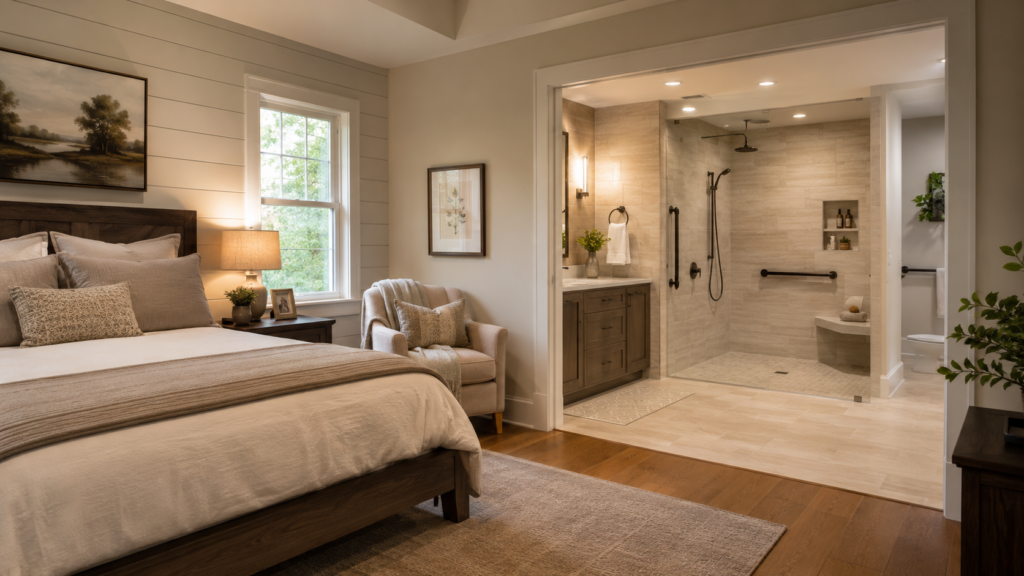
A safer bathroom remodel may include:
- Curbless shower
- Walk-in shower
- Low-threshold entry
- Built-in bench
- Handheld showerhead
- Slip-resistant tile
- Better vanity lighting
- Motion night lighting
- Comfort-height toilet
- Reinforced walls for future grab bars
- Wider shower opening where possible
- Easy-access storage
- Better ventilation
AARP’s research shows that bathroom modifications are among the most expected home changes for older adults planning to age in place. Current aging-in-place bathroom remodeling guidance also emphasizes curbless showers, grab bars, slip-resistant flooring, and accessible layouts that improve safety without sacrificing style.
This is why Bathroom Remodeling is often the first major project in an aging-in-place strategy.
A safer bathroom can also be beautiful. Warm tile, frameless glass, wood vanities, layered lighting, and spa-inspired finishes can make accessibility feel premium.
First-Floor Living Can Protect Long-Term Independence
Stairs can become a challenge over time.
Aging-in-place remodeling often includes planning for first-floor living, especially when homeowners want to remain in the home long term.
A first-floor living strategy may include:
- First-floor bedroom
- First-floor bathroom
- Main-level laundry
- Accessible entry
- Wider pathways
- Safer flooring
- Nearby kitchen access
- Better lighting
- Storage on the main level
- Private suite addition
Some homes already have a room that can be converted. Others may need a Home Addition to create a first-floor suite.
A first-floor suite can also support guests, caregivers, multigenerational living, or recovery after injury. That makes it valuable even before it is urgently needed.
The best time to plan is before mobility becomes a crisis.
A well-designed addition should feel like a natural part of the home, with proper roofline integration, insulation, windows, HVAC coordination, plumbing, and exterior materials.
Better Lighting Reduces Risk and Improves Comfort
Lighting is one of the simplest but most important aging-in-place upgrades.
Poor lighting can make stairs, bathrooms, hallways, kitchens, and outdoor paths harder to use safely.
Aging-in-place lighting may include:
- Brighter bathroom lighting
- Motion-activated night lighting
- Stair lighting
- Hallway lighting
- Under-cabinet kitchen lighting
- Toe-kick lighting
- Exterior pathway lighting
- Porch lighting
- Closet lighting
- Dimmable controls
- Smart lighting scenes
Layered lighting is also a major 2026 design direction across rooms, from kitchens to bedrooms. Recent design trend coverage shows integrated kitchen lighting, warmer bedroom lighting, and more intentional lighting as homeowners move away from single overhead fixtures.
For aging-in-place, lighting is both a design feature and a safety feature.
This is especially important in Full Home Remodeling because lighting should be planned across the whole home, not one room at a time.
Accessible Kitchens Support Daily Independence
The kitchen is another critical area for long-term comfort.
A kitchen that works today may become difficult later if storage is too high, pathways are narrow, lighting is weak, or appliances are poorly located.
An accessible kitchen remodel may include:
- Better lighting
- Wider walkways where feasible
- Pull-out shelves
- Deep drawers
- Easier-to-reach storage
- Lower microwave placement
- Safer flooring
- Clear work zones
- Better appliance placement
- Lever or easy-grip hardware
- Seated prep area where appropriate
- Task lighting
- Reduced clutter
A recent research paper on inclusive kitchen design for older adults emphasizes the importance of better lighting, less clutter, non-slip flooring, and layouts that support visibility and independence.
For homeowners, this means Kitchen Remodeling should be planned around more than style.
A kitchen should support the way people cook, move, reach, clean, and use the space every day.
An accessible kitchen can still feel high-end, warm, and modern.
Safer Outdoor Access Matters Too
Aging-in-place remodeling should not stop inside the home.
Entryways, porches, decks, steps, railings, walkways, and exterior lighting all affect safety.
Outdoor access upgrades may include:
- Safer front steps
- Stronger railings
- Better porch lighting
- Wider landings
- Slip-resistant surfaces
- Low-threshold entry
- Covered entry
- Deck stair lighting
- Better pathway lighting
- More stable porch or deck structure
- Ramps where appropriate
- Seating areas near entry points
This connects directly with Decks & Porches.
A beautiful outdoor space should also be safe and easy to access. Decks, porches, and outdoor rooms can support long-term living when they are designed with clear pathways, secure railings, good lighting, and durable materials.
If an existing porch or deck is damaged, unsafe, or poorly built, Restoration & Rebuild may be the right first step.
Basement Remodeling Can Support Caregivers, Guests, and Family Flexibility
Basements can support aging-in-place planning in several ways.
A finished basement may become:
- Guest suite
- Caregiver suite
- Adult child suite
- Family room
- Home office
- Storage zone
- Hobby room
- Exercise space
- Secondary living area
For multigenerational families, a basement suite can create privacy and flexibility.
However, basements require careful planning. Moisture, lighting, flooring, ventilation, egress, stairs, bathrooms, and accessibility all matter.
A Basement Remodeling project can support long-term household flexibility, but it should be designed realistically. If stairs are a concern, the basement may be better suited for guests or caregivers rather than primary aging-in-place living.
The right strategy depends on the home and family.
Smart Home Features Can Support Aging-in-Place
Smart technology can support aging-in-place when it is simple, reliable, and practical.
Useful smart features may include:
- Motion lighting
- Smart thermostats
- Video doorbells
- Smart locks
- Leak sensors
- Smoke and carbon monoxide alerts
- Voice-controlled lighting
- Security cameras
- Automated exterior lighting
- Smart door sensors
Harvard’s Joint Center for Housing Studies has noted that home automation in aging-in-place renovation projects commonly includes safety, security, and climate control systems.
For homeowners, the goal should be convenience without complexity.
Smart features should support independence, not create frustration.
This is why smart planning should be coordinated during remodeling rather than added randomly afterward.
Repair Unsafe Conditions Before Adding Accessibility Features
Aging-in-place remodeling should begin with the home’s current condition.
Before installing new finishes or accessibility features, homeowners should check for:
- Water damage
- Soft flooring
- Loose railings
- Poor lighting
- Unsafe stairs
- Damaged decks
- Mold or moisture
- Failing tile
- Plumbing leaks
- Outdated electrical work
- Poor previous remodeling
- Foundation concerns
If the home has unsafe or damaged areas, Restoration & Rebuild should come first.
A safer home needs strong construction behind the visible upgrades.
When Should You Consider Aging-in-Place Remodeling?
Aging-in-place remodeling may be a strong decision if your home has any of these issues:
- Bathroom feels unsafe
- Shower or tub is hard to enter
- Stairs are becoming inconvenient
- Lighting is poor
- Kitchen storage is hard to reach
- Entryway has steps or poor lighting
- Flooring is slippery
- Home lacks a first-floor bedroom
- Laundry is difficult to access
- Outdoor spaces feel unsafe
- You want to stay in the home long term
- You are planning for parents or future caregivers
- You want safer design without making the home look medical
The best time to plan is before urgent need.
Aging-in-place remodeling is not about fear. It is about control, comfort, independence, and long-term value.
How H&C Construction Design Build Helps Maryland Homeowners
At H&C Construction Design Build, we help homeowners remodel with safety, comfort, craftsmanship, and long-term planning.
Our aging-in-place remodeling process focuses on five priorities.
1. Understanding Long-Term Goals
We begin by learning how the home should support current comfort, future mobility, family needs, guests, caregivers, and daily routines.
2. Evaluating the Existing Home
We review bathrooms, kitchens, bedrooms, stairs, lighting, flooring, entryways, basements, outdoor spaces, and unsafe conditions.
3. Planning the Right Remodeling Strategy
We help homeowners decide whether the best path is bathroom remodeling, first-floor suite additions, kitchen remodeling, deck and porch upgrades, basement remodeling, restoration, or full-home remodeling.
4. Coordinating Construction Professionally
We manage layout changes, plumbing, electrical work, lighting, waterproofing, flooring, framing, additions, and finish details with attention to safety and quality.
5. Building for Long-Term Value
We focus on creating homes that feel beautiful, comfortable, safer, and more adaptable for the future.
Whether you need an accessible bathroom in Rockville, a first-floor suite in Bethesda, safer kitchen remodeling in Potomac, porch upgrades in Silver Spring, or full-home remodeling in Montgomery County, H&C Construction can help you remodel with purpose and craftsmanship.
View Our Remodeling Projects to start planning.
Build a Home That Supports Every Stage of Life
Aging-in-place remodeling in Maryland is one of the smartest ways to protect comfort, independence, and long-term home value.
In 2026, homeowners are choosing safer bathrooms, curbless showers, first-floor suites, better lighting, accessible kitchens, stronger entryways, and full-home remodeling strategies because they want homes that support life today and tomorrow.
The best aging-in-place remodels do not look clinical. They look intentional, warm, modern, and well built.
If your home needs to become safer, more comfortable, and more future-ready, H&C Construction Design Build can help you plan the right next step.
Explore Full Home Remodeling, Bathroom Remodeling, Home Additions, Kitchen Remodeling, and General Contractor in Maryland, with H&C Construction Design Build today.
Free consultation
Ready to Start Your Full Home Remodeling Project?
H&C Construction serves Maryland, Virginia, and Washington DC. Get a free consultation today.
Local service areas
Remodeling Guides Near You
Planning home renovation in Montgomery County? Browse local guides by city — permits, neighborhoods, and recent H&C Construction projects.
City hubs