Basement Remodeling in Maryland: Turning Unused Space Into a Legal Bedroom, Home Theater, or Gym in 2026
For many homeowners in Rockville, Silver Spring, Gaithersburg, and across Montgomery County, the basement is the most underused space in the house — a place for storage boxes, an old treadmill, and not much else. At the same time, these same homeowners are looking for more bedrooms, more entertaining space, or a dedicated home gym, and wondering whether an addition is really the answer.
In 2026, more DMV homeowners are answering that question by looking down instead of out. Basement remodeling has become one of the most cost-effective ways to add genuinely usable living space — and when done correctly, with proper egress and permitting, a finished basement can include a legal bedroom, a home theater, a home gym, or a private guest suite.
At H&C Construction Design Build, we design and build basement remodels across Maryland, Washington DC, and Northern Virginia. This guide covers what homeowners need to know before starting — including the egress window requirements that are central to almost every basement bedroom project.
Why Basement Remodeling Is Surging in the DMV
The shift toward basement remodeling isn’t happening in isolation. Across Montgomery County, the broader pattern is clear: homeowners are increasingly investing in the homes they already own rather than building additions or moving. Interior renovations — including basements, kitchens, and bathrooms — have seen significant growth in permitted projects over the past several years, even as home addition permits have declined.
There are a few clear reasons for this shift:
It’s often less expensive than an addition. A basement remodel uses space that already exists within the home’s footprint — no new foundation, no roofline changes, no exterior structural work in most cases.
It delivers strong resale value. A professionally finished basement with a legal bedroom and bathroom can be listed as additional bedroom and living space — a meaningful difference in a competitive resale market across Bethesda, Arlington, and Fairfax.
It supports changing household needs. Whether it’s a home office for remote work, a guest suite for visiting family, or a private space for an adult child or aging parent, a finished basement adds flexibility that many DMV homes currently lack.
Egress Windows: The Most Important Thing to Understand
If there’s one technical requirement that comes up in nearly every basement bedroom conversation, it’s egress windows.
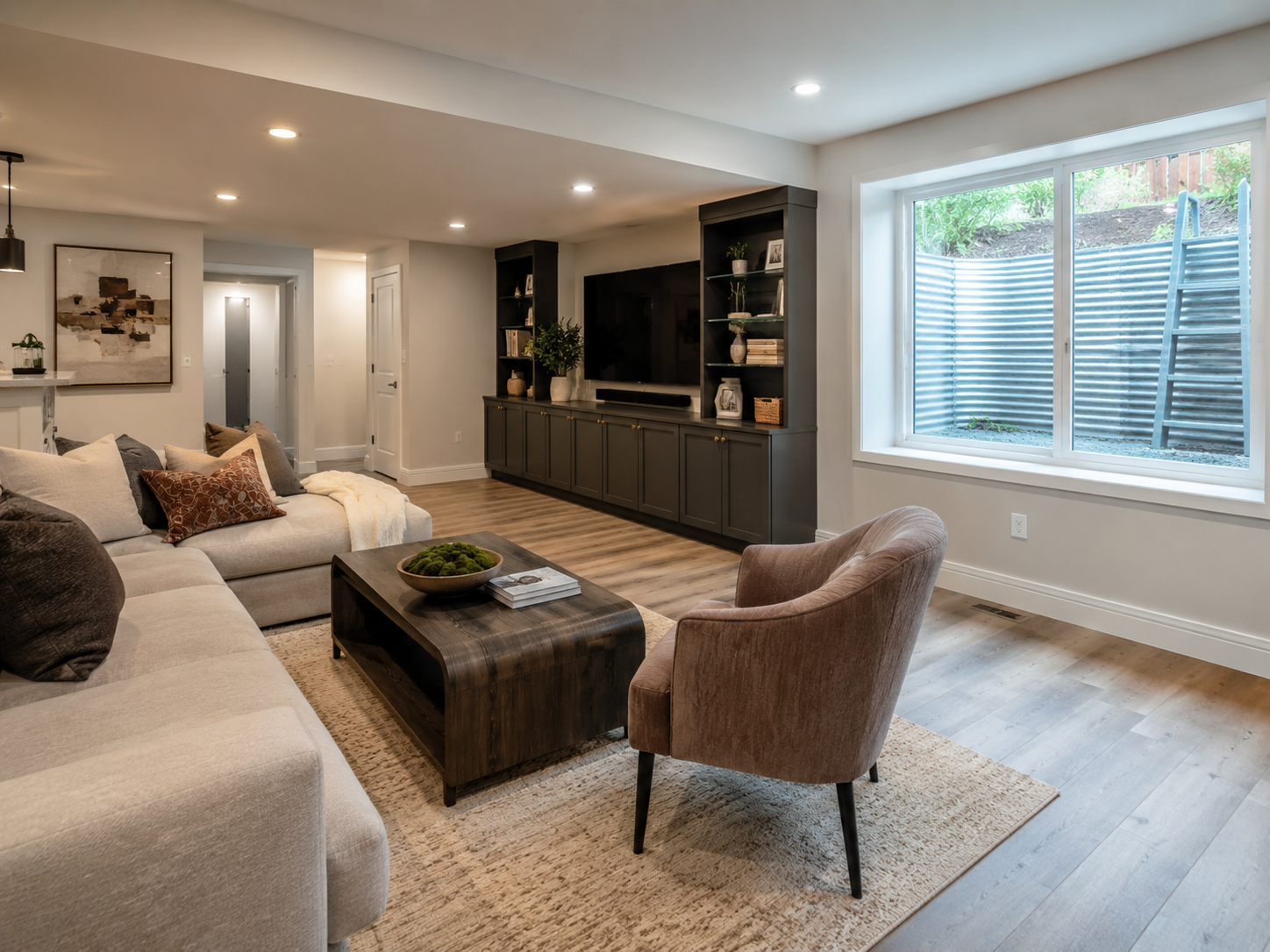
Building codes across Maryland, DC, and Virginia require that any basement room used as a bedroom have a proper egress window — an opening large enough for a person to escape through in an emergency, and for first responders to enter. Specific requirements generally include a minimum net clear opening, minimum width and height dimensions, and a maximum sill height from the floor, along with an appropriately sized window well where the window sits below grade.
Here’s why this matters beyond code compliance:
Without an egress window, a basement room cannot legally be called a bedroom — regardless of how it’s finished or furnished. This affects how the space can be marketed at resale and, in some cases, how it’s valued by appraisers.
Egress windows bring natural light into the basement, which dramatically changes how the space feels — turning a dark, cave-like room into a bright, comfortable living area.
Egress window installation involves cutting into the foundation wall and installing a window well, which requires careful waterproofing and drainage planning to prevent future moisture issues.
Because of the structural and waterproofing considerations involved, egress window installation should always be handled by Licensed Contractors in Maryland who understand both the code requirements and the building science involved.
Beyond the “Rec Room”: What Homeowners Are Building in 2026
One of the clearest shifts in basement remodeling is away from the generic “rec room” of years past and toward purpose-built, specialized spaces. The basements we’re designing today are built around specific uses:
Legal Bedroom and Guest Suite
With a properly installed egress window, a full bathroom, and adequate ceiling height, a basement bedroom can function as a private guest suite, a space for visiting family, or — increasingly — a long-term living space for an adult child or aging parent. Pairing this with an accessible Bathroom Remodeling design creates a genuinely independent living area.
Home Theater
Dedicated home theaters are one of the fastest-growing basement project types in the DMV. These spaces typically include acoustic treatments on walls and ceilings, tiered or staggered seating, dedicated electrical circuits for AV equipment, and lighting designed for both movie-watching and general use. Acoustic isolation also matters for the rest of the house — a well-designed theater shouldn’t be audible from the floors above.
Home Gym
Home gyms have become one of the most requested basement uses, particularly for homeowners who want to avoid commuting to a commercial gym. Key considerations include reinforced flooring to handle heavy equipment, mirrors and adequate lighting, proper ventilation and humidity control, and sometimes rubber flooring systems that protect the subfloor while reducing noise transmission to upper floors.
Multi-Purpose Flex Spaces
Many homeowners choose a layout that can adapt over time — a space that functions as a playroom today, a teen hangout in a few years, and a home office or guest suite after that. Designing for this kind of flexibility from the start avoids costly reconfigurations down the road.
Secondary Living Areas with Kitchenettes
For homeowners planning for long-term multigenerational needs, a basement with a small kitchenette — a sink, mini-fridge, and cabinetry — adds genuine independence for guests or family members staying for extended periods.
Moisture: The Issue That Determines Everything Else
Before any basement remodeling project begins, moisture conditions need to be properly assessed. A basement with existing moisture issues — whether from grading, gutters, foundation cracks, or hydrostatic pressure — will cause serious problems for a finished space if those issues aren’t addressed first.
Finishing a basement that has unresolved moisture problems doesn’t just risk damage to new finishes; it can create mold and air quality issues that affect the health of the home. This is one of the most important — and most often overlooked — steps in basement planning.
If your basement has a history of dampness, water intrusion, or visible foundation issues, our Restoration & Rebuild team can assess and resolve these issues as part of your remodeling plan, ensuring the finished space stays dry and healthy for years to come.
What a Basement Remodel Typically Involves
A full basement remodel touches more systems than most homeowners initially expect:
Framing and insulation. New walls are framed against foundation walls, with appropriate insulation for energy efficiency and moisture management.
Electrical. Most unfinished basements need significant electrical work — additional circuits, outlets, lighting, and often a panel upgrade to support the new space.
HVAC. Basements often need dedicated heating and cooling — either extending existing ductwork or adding supplemental systems — to stay comfortable year-round.
Plumbing. Adding a bathroom or kitchenette requires new plumbing lines, and depending on the home’s existing layout, may require a sewage ejector pump system.
Egress windows. As discussed above, any bedroom requires a code-compliant egress window and window well.
Flooring and finishes. Moisture-resistant flooring options — luxury vinyl plank, certain engineered woods, or tile — are typically preferred over carpet directly on concrete in below-grade spaces.
Smoke and CO detection. Modern code requirements typically call for hardwired, interconnected smoke and carbon monoxide detectors throughout finished basement spaces.
Permits and the Basement Remodeling Process
Basement remodeling projects in Maryland, DC, and Northern Virginia require permits — and in most jurisdictions, a basement with a new bedroom, bathroom, or significant electrical and plumbing work requires multiple permit types and inspections at various stages of construction.
At H&C Construction, our process is designed to take this complexity off your plate:
Initial consultation and assessment. We evaluate the space, check for moisture issues, assess ceiling height and egress feasibility, and discuss how you want to use the space.
Design development. We create a layout that addresses your goals — whether that’s a bedroom suite, theater, gym, or flexible multi-purpose space — along with mechanical and electrical planning.
Permit coordination. We handle permit submissions with the relevant county or municipal building department, including egress window permits where applicable.
Construction. Our licensed crews manage every phase — framing, electrical, plumbing, HVAC, egress window installation, and finishes — under one coordinated schedule.
Final inspection and walkthrough. We coordinate required inspections and walk through the completed space with you.
You can see examples of completed basement transformations in our Our Remodeling Projects portfolio.
Is Your Basement a Good Candidate?
Before committing to a basement remodel, a few questions are worth considering:
Is the ceiling height adequate? Most jurisdictions require a minimum ceiling height for habitable space — typically around 7 feet. Basements with ductwork or beams that drop below this threshold may need creative solutions.
Is there a history of water intrusion? If yes, this needs to be resolved before finishing begins — not worked around.
Is there a feasible location for an egress window? This depends on your home’s grading and foundation wall layout, and should be assessed early in the design process.
What’s the long-term goal for the space? A bedroom for a returning adult child has different requirements than a home theater or gym — and planning for flexibility now can save money later.
A professional consultation is the best way to answer these questions for your specific home.
The ROI of a Finished Basement in Maryland and Virginia
Among major remodeling categories, finished basements consistently rank as one of the strongest investments for cost recoup at resale — often cited around 70% of project cost returned in home value, with additional benefits from the functional living space gained in the meantime.
For homeowners in Bethesda, Arlington, and across the DMV, a basement remodel offers something an addition often can’t: a faster timeline, lower disruption to the rest of the home, and a meaningful increase in usable square footage without changing the home’s exterior footprint.
Ready to Plan Your Basement Remodel?
H&C Construction Design Build serves homeowners across Maryland, Washington DC, and Northern Virginia — including Rockville, Bethesda, Potomac, Silver Spring, Chevy Chase, Gaithersburg, Montgomery County, Arlington, Alexandria, and Fairfax. Whether you’re planning a legal bedroom, a home theater, a gym, or a flexible multi-purpose space, our design-build team handles every step — including egress windows, permitting, and moisture management.
Explore our Basement Remodeling service and request a consultation to start your project.