Posted on Leave a comment

Transit-Oriented Development Maryland 2026, Unlocking Station Equity

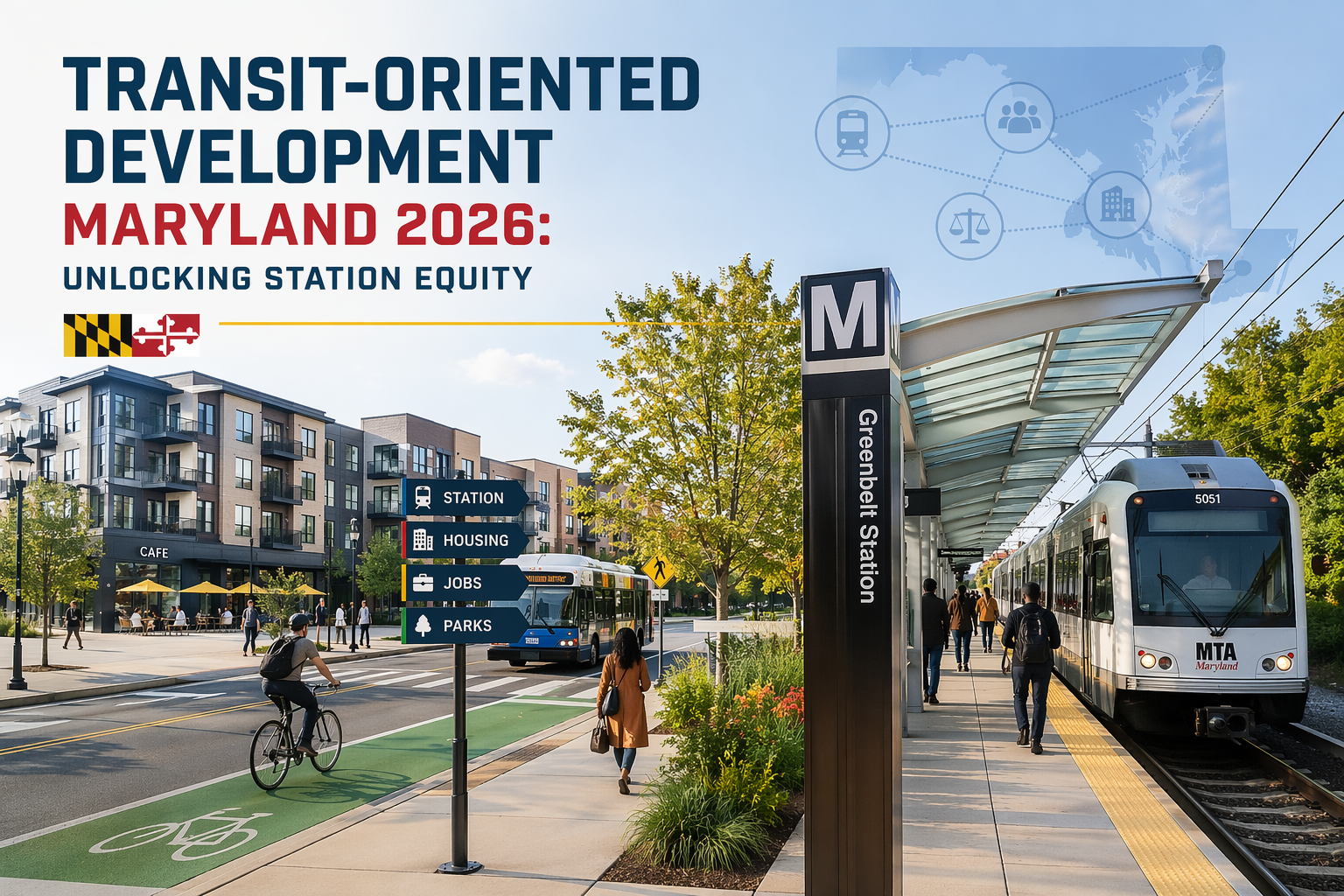
Professional editorial cover image showing a modern Maryland transit-oriented development scene with a light rail train at Greenbelt Station, mixed-use apartment buildings, a café, pedestrians, a cyclist, a bus, and a protected bike lane. Large headline text reads “Transit-Oriented Development Maryland 2026: Unlocking Station Equity,” with Maryland flag icons and graphics suggesting transit, housing, jobs, and community connectivity.

The 7,000-Unit Surge: Leveraging Maryland’s New Zoning Reforms for 2026

As of April 16, 2026, the legislative landscape for Maryland property owners has fundamentally shifted. Following the official adjournment of the General Assembly, the Maryland Transit and Housing Opportunity Act (HB 894) has officially moved to “Passed Enrolled” status. This historic legislation unlocks over 300 acres of state-owned land for high-density, mixed-use development and streamlines the process for private homeowners to scale their own “Functional Density.

For homeowners in Silver Spring, College Park, and Rockville, this represents a generational equity play. The Act effectively removes the “Red Tape” that has historically suppressed property values near rail corridors. Consequently, Home Value Appreciation in Maryland is now tied directly to a property’s proximity to frequent transit and its ability to adapt to new zoning bypasses.

1. Eliminating the Parking Tax on Progress

One of the most radical shifts in the 2026 Act is the elimination of minimum parking requirements for developments within a quarter-mile of high-quality transit. Previously, homeowners wishing to execute a Home Additions project were often forced to sacrifice valuable square footage—and thousands of dollars—to meet outdated parking mandates.

Accordingly, you can now utilize your entire lot footprint for high-end living space or detached accessory units. By shifting the focus from “cars to people,” your property captures the Enterprise Zone tax incentives now automatically designated to these transit-oriented development (TOD) areas, allowing you to prioritize Kitchen Remodeling and high-end finishes over asphalt and concrete.

2. Scaling with the “Silver Homes” Advantage

Parallel to the TOD Act, the Starter and Silver Homes Act of 2026 has redefined what is possible on a standard residential lot. This legislation allows for smaller single-family footprints and the easier division of lots to build “Silver Homes”—high-performance, downsized luxury units.

Whether you are performing a Basement Remodeling to create a legal rental suite or building a detached “Sanctuary” ADU, these new laws ensure that your project is protected from local regulatory delays. Finally, by utilizing the Housing Certainty Act of 2026, once your project is approved, the rules are “locked in,” preventing the surprise impact fees that previously derailed large-scale Bathroom Remodeling and expansion projects.

3. Acoustic Isolation: The Premium of Privacy

As density increases near Maryland’s transit hubs, the definition of luxury has moved from “space” to “Acoustic Resilience.” Our Restoration & Rebuild services for transit-adjacent homes now prioritize STC-rated glass and specialized Flooring underlayments to eliminate vibration and urban noise.

Integrating these technical upgrades during your Full Home Remodeling ensures that your property remains a quiet sanctuary while benefiting from the massive infrastructure investments currently flowing into Maryland’s rail corridors. Furthermore, adding a four-season Decks & Sunrooms transition provides the indoor-outdoor connectivity that 2026 buyers prioritize in high-density areas.


Capitalize on the 2026 Zoning Shift Today

The zoning gates have officially opened. Are you ready to move your property from a “Standard Lot” to a “High-Yield Asset”? As a leading General Contractor in Maryland, we help you navigate these legislative shifts to maximize your ROI.

Explore our specialized 2026 design-build services:
Posted on Leave a comment

All-Electric Building Code Montgomery County 2026, The New Standard

The Post-Court Reality, Navigating the 2026 All-Electric Mandate

As of April 16, 2026, the architectural landscape of the DMV has reached a definitive turning point. Following the landmark U.S. District Court ruling on March 25, 2026, which upheld Montgomery County Bill 13-22, all-electric construction is no longer a sustainable “option”—it is the legally enforced benchmark for luxury real estate.

For homeowners in Bethesda and Rockville, this ruling confirms that the “Decarbonization Law” is fully active. Consequently, any Full Home Remodeling project initiated this spring must pivot away from fossil fuel infrastructure to avoid future compliance penalties and to preserve Home Value Appreciation in Maryland.

1. The Performance Shift: Why Induction is the New Luxury

The court’s decision affirms that local jurisdictions possess the legal authority to phase out fossil fuel appliances in new and substantially renovated structures. Accordingly, your Kitchen Remodeling project should no longer be designed around a traditional gas range.

Instead, we are integrating High-Performance Induction Suites that offer 90% energy transfer efficiency—nearly double that of gas. Beyond performance, the shift is driven by Indoor Air Quality (IAQ); induction eliminates the nitrogen dioxide (NO2) and carbon monoxide emissions that the 2026 Healthy Homes standards now explicitly flag. By removing gas lines now, you satisfy Net-Zero standards and secure a higher appraisal in a market that is hyper-sensitive to “brown-to-green” asset transitions.

2. Infrastructure Resilience: The 400-Amp Standard

Transitioning to an all-electric sanctuary requires a total system audit that exceeds basic aesthetics. Whether you are executing a Basement Remodeling to create an independent living suite or an extensive Home Additions project, your electrical backbone must be “Decarbonization Ready.”

Currently, the 2026 gold standard for a high-performance estate is an upgrade to 400-amp service. This capacity is a mechanical necessity to simultaneously power:

  • High-Efficiency Heat Pump Water Heaters that draw significant peak loads.

  • Whole-Home HVAC Heat Pumps capable of maintaining comfort in Maryland’s shifting humidity.

  • Dual Level-2 EV Charging Stations, which 92% of luxury buyers now demand as a standard amenity.

Partnering with a General Contractor in Maryland who understands these complex technical load calculations is the only way to ensure your high-end finishes aren’t undermined by an obsolete electrical spine.

3. Scaling Value Through Decarbonized Restoration

With the Maryland EmPOWER Act incentives reaching record levels this month, the financial case for electrification is undeniable. Homeowners who integrate solar-ready roofing and smart energy monitors during a Restoration & Rebuild phase are seeing a direct reduction in annual carry costs by up to 35%.

Furthermore, upgrading your Flooring to support radiant electric heating or high-thermal-mass materials can further optimize your home’s energy envelope. Finally, completing your Bathroom Remodeling with a high-performance heat-pump dryer and steam shower ensures every square inch of your home aligns with the “Full Electric” mandates that are now the prerequisite for a premium sale in 2026.


Lead the Decarbonization Transition

The shift to all-electric is a challenge for some, but a massive equity opportunity for those who lead. Are you ready to future-proof your estate? Explore our specialized 2026 technical services: