
Multigenerational Home Remodeling in Maryland and Northern Virginia: How to Build for Every Generation Under One Roof
Across Maryland, Washington DC, and Northern Virginia, a quiet but significant shift is happening inside existing homes. Aging parents are moving in. Adult children are staying longer. Grandparents need accessible spaces. Families are rethinking how their homes function — not just for today, but for the next ten to twenty years.
Multigenerational living is no longer a temporary arrangement. It is a deliberate, long-term choice that an increasing number of DMV families are making, and remodeling is how they make it work. In Bethesda, Potomac, Silver Spring, Arlington, and Fairfax, homeowners are investing in first-floor bedroom suites, in-law additions, accessible bathrooms, secondary kitchen spaces, and finished basement guest quarters — all with the goal of creating a home that genuinely serves every person under the roof.
At H&C Construction Design Build, we have extensive experience designing and building multigenerational remodels across Maryland, DC, and Northern Virginia. This guide covers what to plan for, what to build, and how to approach the process the right way.
Why Multigenerational Remodeling Is Accelerating in the DMV
Several forces are converging to make multigenerational living the fastest-growing household category in the country.
Housing costs. The DMV is one of the most expensive housing markets in the United States. Adult children who cannot afford independent housing in Rockville, Arlington, or Alexandria are staying in the family home longer — or returning after college and early career. A thoughtfully remodeled basement suite or private first-floor space makes that arrangement genuinely comfortable for everyone.
Aging population. According to AARP, approximately 75% of older adults want to remain in their own homes as they age. But most homes in the DMV were built in the 1960s, 70s, and 80s without any consideration for accessibility or mobility limitations. Stairs, narrow doorways, standard-height toilets, and shower-over-tub configurations become genuine obstacles for aging family members. Remodeling eliminates those obstacles.
Caregiving costs. The cost of assisted living and memory care in Maryland and Northern Virginia is among the highest in the nation. For many families, a well-designed in-law suite — with a private bedroom, accessible bathroom, and kitchenette — is a dramatically more affordable and emotionally preferable alternative.
Equity leverage. Homeowners in Montgomery County, Fairfax County, and Northern Virginia have accumulated significant equity. Using that equity to remodel for multigenerational functionality is a high-ROI decision that simultaneously improves daily quality of life and expands the home’s buyer pool at resale.
What Multigenerational Remodeling Actually Involves
There is no single template. Multigenerational remodeling looks different depending on who is moving in, what their physical needs are, and what the existing home allows. The most common project types we see in the DMV are:
First-Floor Primary Suite Conversion or Addition
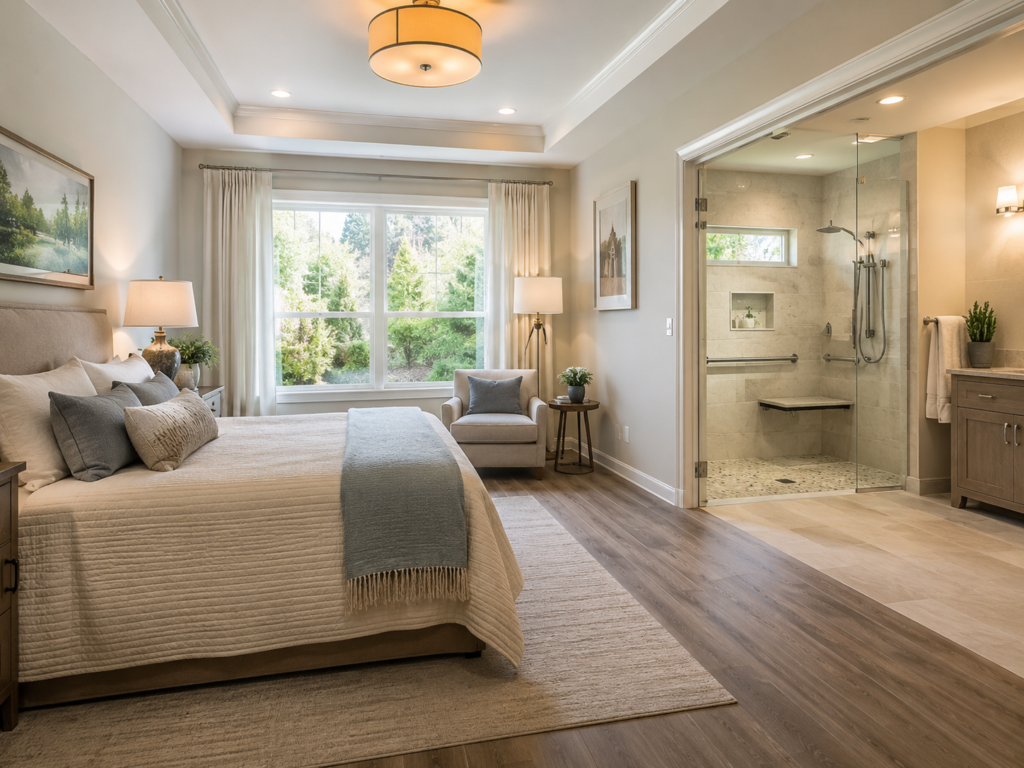
This is the most common project for families accommodating aging parents or a family member with mobility limitations. The goal is to create a full bedroom and accessible bathroom on the main level of the home — eliminating the need to navigate stairs for daily living.
In homes with sufficient main-level square footage, this sometimes means converting an existing room or converting formal living and dining space into a bedroom suite. In homes without available square footage, a Home Additions project adds the footprint needed.
A first-floor suite designed for aging in place should include:
- Wide doorways — 36 inches minimum — to accommodate wheelchairs and walkers
- A curbless or zero-threshold shower with grab bars and a built-in bench
- A single-level vanity with knee clearance for seated use
- Non-slip flooring
- Lever-style door hardware and faucets
Our Bathroom Remodeling team designs accessible bathrooms that are both beautiful and fully functional for aging-in-place needs.
In-Law Suite Addition
For families who want genuine privacy for both generations, a dedicated in-law suite — either attached to the main home or as a separate accessory structure — is the strongest long-term solution. These projects typically include a private entrance, a bedroom, a full bathroom, a kitchenette or small kitchen, and a living area.
In Maryland, regulations around accessory dwelling units (ADUs) and in-law suites vary by county and municipality. Montgomery County has specific zoning rules regarding attached and detached accessory structures. Navigating those regulations correctly from the start — with a licensed General Contractor in Maryland — prevents costly redesigns and permit complications later.
Basement Guest Suite or Independent Living Space
A professionally finished basement can function as a fully independent living level for a family member who wants privacy without a separate structure. Basement projects for multigenerational use typically include a bedroom, a full bathroom, a living area, and often a kitchenette.
Egress window installation — required by code for any bedroom in a basement — is a critical component. Proper insulation, moisture management, and HVAC zoning ensure the space is genuinely comfortable year-round.
Our Basement Remodeling team specializes in converting underutilized lower levels into livable, code-compliant spaces that add real value to the home.
Full Home Reconfiguration
Some multigenerational projects require rethinking the entire floor plan — not just adding a room. Older Colonial and split-level homes common in Chevy Chase, Silver Spring, and Gaithersburg often have layouts that work against both privacy and accessibility. A full home reconfiguration under our Full Home Remodeling service addresses flow, acoustics, lighting, and spatial separation in a coordinated single project.
Secondary Kitchen or Kitchenette
Multigenerational households often need more than one kitchen — or at minimum a kitchenette space that allows independent meal preparation. We incorporate kitchenette stations into in-law suites and basement suites regularly. For homes where the main kitchen is shared between generations, a kitchen expansion or layout reconfiguration can dramatically improve daily function.
Explore our Kitchen Remodeling service for full kitchen upgrades, layout changes, and secondary kitchen installations.
Design Principles That Make Multigenerational Homes Work
The difference between a multigenerational home that functions beautifully and one that creates daily friction comes down to design intent from the start. The best projects we deliver in the DMV are built around a few core principles.
Acoustic separation. Two households sharing one structure need sound privacy. This means insulated interior walls, solid-core doors, and thoughtful placement of shared mechanical systems. It is much easier to build acoustic separation into a remodel than to retrofit it.
Visual privacy without isolation. Private entrances, separate outdoor access, and separate mail or package areas create independence without making any family member feel cut off. A side entrance through a covered porch or mudroom zone is worth building into the plan.
Universal design elements throughout. Wider hallways, lever hardware, no-step entrances, and adequate lighting benefit every member of a multigenerational household — not just the aging family member. Designing universally also protects resale value, as accessibility is an increasingly important factor for buyers.
Flexible functionality. The best multigenerational suites are designed to convert. A first-floor suite that functions as a guest room today and an in-law suite in five years — or eventually a home office, a short-term rental, or an accessible space for the homeowner — is a smarter investment than one designed for a single narrow use.
Permits, Zoning, and What to Know in Maryland and Virginia
Multigenerational remodeling projects almost always require permits, and many require zoning review — particularly when a separate entrance is involved or when a new structure is being added.
In Montgomery County, Maryland, rules around ADUs and accessory apartments have evolved in recent years. The Maryland Transit & Housing Opportunity Act created additional flexibility in some jurisdictions, but projects still require careful review before design is finalized. In Fairfax County, Arlington, and Alexandria, Virginia, similar processes apply.
Our team at H&C is deeply familiar with permitting requirements across Maryland, DC, and Northern Virginia. As Licensed Contractors in Maryland, we manage permit applications, coordinate inspections, and ensure every phase of your project is code-compliant from the start.
What to Expect from the Planning Process
Multigenerational remodeling is not a weekend project or a quick decision. The most successful outcomes we see come from families who invest real time in the planning phase — thinking through not just what they’re building now but what they might need in five or ten years.
Here is how H&C Construction structures the process:
Initial consultation. We visit the home, assess the existing conditions, and discuss the goals of each generation involved. Who is moving in? What are their current and anticipated physical needs? What budget is available? What timeline works for the family?
Design development. We develop a plan that addresses the layout, materials, accessibility features, and any structural modifications. For projects involving additions, structural drawings are prepared for permit submission.
Permit coordination. We handle all permit applications and compliance review with the relevant county agencies in Maryland, DC, or Virginia.
Construction. Our licensed crews manage all phases of construction — structural, mechanical, finish work — under a single design-build contract.
Project walkthrough. We conduct a final walkthrough with the family and address any punch list items before closing the project.
You can see examples of our completed work in our Our Remodeling Projects portfolio.
The Right Time to Start Planning
The families who are most satisfied with their multigenerational remodels are the ones who planned proactively — before a health event forced a rushed decision, and before seasonal demand made contractor scheduling difficult.
If you know that aging parents may be moving in within the next one to three years, the time to begin design conversations is now. Projects that are planned carefully, permitted properly, and built by a licensed design-build team deliver results that last — and that protect the equity of one of your most significant assets.
Whether you are planning a first-floor suite, a basement guest space, or a full home reconfiguration, H&C Construction is ready to help you build a home that works for everyone in it.
Ready to Plan Your Multigenerational Remodel?
H&C Construction Design Build serves homeowners across Maryland, Washington DC, and Northern Virginia — including Rockville, Bethesda, Potomac, Silver Spring, Chevy Chase, Gaithersburg, Arlington, Alexandria, Fairfax, and Montgomery County. We design and build multigenerational homes that are accessible, comfortable, and built to last.
Request a consultation to start your planning process today.
Free consultation
Ready to Start Your Full Home Remodeling Project?
H&C Construction serves Maryland, Virginia, and Washington DC. Get a free consultation today.
Local service areas
Remodeling Guides Near You
Planning home renovation in Montgomery County? Browse local guides by city — permits, neighborhoods, and recent H&C Construction projects.
City hubs