
Low-Maintenance Exterior Remodeling in Maryland and Northern Virginia: Siding, Materials, and Upgrades Built for the DMV Climate
Maryland and Northern Virginia put home exteriors through a genuine test. Humid summers push moisture into every material that isn’t properly engineered to resist it. Seasonal freeze-thaw cycles expand and contract siding, trim, and caulking year after year. Summer storms bring wind, hail, and heavy rain that expose weak points in any exterior system. For homeowners in Bethesda, Rockville, Potomac, Silver Spring, Arlington, and Fairfax, the question isn’t just what looks good — it’s what holds up.
Because of this, low-maintenance exterior materials have moved from a premium preference to a mainstream priority across the DMV. Homeowners who spent years repainting wood siding, replacing rotted trim, or watching composite boards warp in Maryland’s summer heat are choosing differently now. The right exterior system, properly installed, protects your home for decades with significantly less upkeep than what many existing homes currently have.
At H&C Construction Design Build, we help homeowners across Maryland, Washington DC, and Northern Virginia plan and execute exterior remodeling projects that perform in this specific climate. Here’s what you need to know.
Why the DMV Climate Demands Better Exterior Materials
Maryland and Northern Virginia homeowners face a combination of weather conditions that are particularly hard on exterior materials.
High humidity and summer moisture. The DC metro area regularly experiences humidity levels above 80% in summer months. As a result, any wood-based siding material that isn’t properly sealed and maintained becomes vulnerable to moisture infiltration, rot, and mold growth. Most wood siding on older DMV homes requires repainting or resealing every three to five years to maintain that protection — and many homeowners fall behind.
Freeze-thaw cycles. Maryland winters produce repeated cycles of freezing and thawing that cause materials to expand and contract. Over time, this movement cracks caulk, opens seams, and creates pathways for moisture intrusion behind siding. Materials with poor dimensional stability — particularly lower-grade vinyl and older composite siding — are especially vulnerable.
Summer storms and wind. As discussed in H&C’s storm-readiness guide, late June through September brings significant storm exposure across the DMV. High winds can loosen or lift inadequately fastened siding panels. Driven rain finds its way through any weak point in the exterior envelope.
Pest pressure. Termites are a genuine concern in Maryland and Northern Virginia. Traditional wood siding and trim is a prime target. Materials that eliminate wood fiber from their composition remove this vulnerability entirely.
Fiber Cement Siding: The Gold Standard for the DMV Market
Fiber cement has become the dominant high-performance siding choice for Maryland and Northern Virginia homes — and the data supports why. Fiber cement appeared on approximately 21% of new single-family homes nationally in recent years, a share that continues growing. In DMV remodeling projects, its market share is higher still, because the climate conditions that make fiber cement valuable are exactly the conditions homeowners here face.
What fiber cement is. Fiber cement is a composite material made from Portland cement, sand, and cellulose fibers — essentially engineered to deliver the aesthetic of natural wood with the structural performance of masonry. It cannot rot, it will not warp or swell with moisture absorption, it resists termites and other pests, and it carries Class A fire resistance. James Hardie’s HardiePlank product line — the most widely specified fiber cement brand — now carries a 30-year non-prorated limited transferable warranty on the substrate.
How it performs in Maryland’s climate. Because fiber cement doesn’t absorb moisture the way wood does, it is resistant to the mold and mildew growth that high humidity accelerates in organic materials. Similarly, its dimensional stability under temperature swings addresses the freeze-thaw vulnerability that deteriorates vinyl and wood. TW Ellis, a Maryland remodeling contractor, describes fiber cement as one of the most durable options for the Maryland climate specifically because of its resistance to moisture and seasonal expansion and contraction.
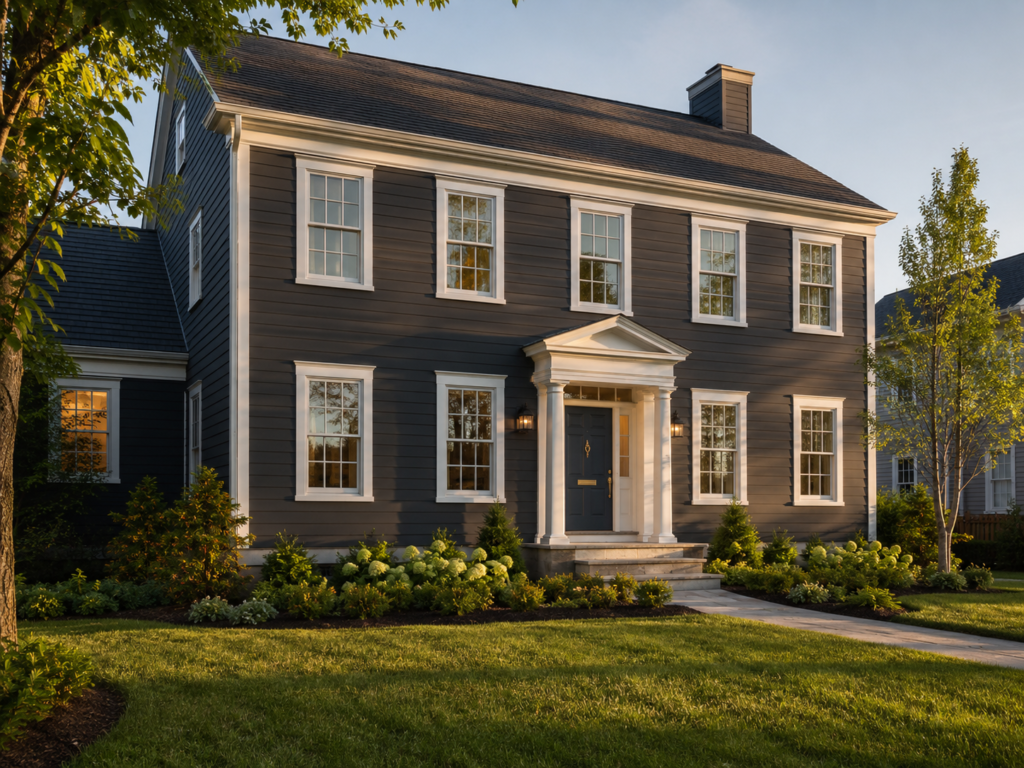
What it looks like. Modern fiber cement siding — particularly capped and factory-primed products — closely replicates the visual texture and profile of natural wood siding, including wood grain, shake, and board-and-batten profiles. Factory-applied finishes, such as James Hardie’s ColorPlus Technology, bake color directly into the coating for superior adhesion and color retention. The 2026 James Hardie Color of the Year is Iron Gray — a deep, sophisticated charcoal that pairs well with the warm-toned trim details trending across the DMV market.
Maintenance reality. Fiber cement siding requires repainting every 10 to 15 years rather than the 3 to 5 years typical of bare wood siding. Between painting cycles, it requires little more than occasional cleaning. For homeowners accustomed to wood siding’s annual maintenance demands, this is a significant improvement.
Vinyl Siding: When It Works, and When It Doesn’t
Vinyl siding remains the most widely installed siding type in Maryland due to its affordability and availability. However, not all vinyl siding performs equally in the DMV climate — and this distinction matters.
Higher-quality vinyl products with adequate panel thickness — generally 0.044 to 0.046 inches or above — perform well in Maryland and Virginia. They resist rot, insects, and moisture, and they come in a wide range of profiles and colors. For homeowners whose primary priority is an affordable, low-maintenance exterior update, quality vinyl is a legitimate option.
Lower-grade vinyl, however, presents meaningful problems in Maryland’s climate. Standard weight vinyl can become brittle over time under UV exposure. More importantly, it is susceptible to warping in Maryland’s intense summer heat — particularly on south- and west-facing walls. In addition, lower-grade vinyl rattles and loosens in high winds if not properly installed with appropriate expansion gaps.
The installation quality matters as much as the product quality. Vinyl that doesn’t allow adequate expansion and contraction buckles in summer heat. An experienced General Contractor in Maryland who understands these material properties is critical to a vinyl installation that performs long-term.
Engineered Wood Siding: A Middle Ground Worth Considering
Engineered wood siding — such as LP SmartSide — blends wood fiber and resin into a product that resists rot, insects, and swelling better than traditional wood, while providing a more authentic wood grain appearance than vinyl. It is lighter than fiber cement, easier to work with, and typically priced between vinyl and fiber cement.
In the DMV market, engineered wood is most commonly chosen when homeowners want the visual warmth of natural wood with better performance than traditional wood siding. It carries a 5/50 limited warranty — five years of full replacement coverage, then 50 years of prorated coverage. However, it does require that factory-applied primer finishes be maintained with paint, and moisture management around windows, doors, and trim is important to its long-term performance.
Exterior Trim: Where Many Homeowners Underinvest
Siding gets most of the attention in exterior remodeling conversations. In practice, exterior trim — corner boards, window trim, fascia, and soffit — is often the first place a home’s exterior shows age and requires maintenance. Because of this, coordinating trim material upgrades with a siding project delivers meaningfully better long-term results than simply replacing siding while leaving painted wood trim in place.
Non-rot materials for trim — including PVC trim boards and fiber cement trim products — eliminate the wood rot, paint failure, and pest vulnerability that make traditional wood trim a recurring maintenance cost. In Maryland and Northern Virginia, where moisture and temperature swings are constant, non-rot trim materials deliver a low-maintenance exterior system rather than simply a low-maintenance siding.
Exterior Color Trends for Maryland and Northern Virginia Homes in 2026
Along with material selection, color decisions carry significant weight in exterior remodeling — both for curb appeal and for long-term resale value.
In 2026, DMV exterior color trends reflect the same warmth-over-minimalism shift visible in kitchen and bathroom design. The 2026 James Hardie Color of the Year, Iron Gray, is emblematic of this direction — a deep, sophisticated neutral that reads as contemporary without being stark. Warm charcoal tones paired with crisp white or cream trim are dominant across new construction and renovation in Bethesda and Potomac.
Beyond the leading charcoal trend, other popular 2026 exterior palettes for Maryland and Northern Virginia homes include:
- Warm greige and taupe with deep navy or black trim accents
- Soft warm white with bronze or dark charcoal trim for a clean contemporary look
- Sage green for homes with strong landscaping and a more organic aesthetic
Color decisions matter especially for fiber cement siding, because factory-applied finishes come with specific color options and warranty implications. Choosing a factory-applied color — rather than field-painted — delivers superior adhesion, color consistency, and longer intervals between repainting.
What Exterior Remodeling Actually Involves
A quality exterior remodel is a more comprehensive project than most homeowners initially anticipate. Because of this, understanding the full scope helps avoid mid-project budget surprises.
Removing existing siding. In most cases, the right approach is a full tear-off of existing siding down to the sheathing — allowing an inspection of what’s behind the siding and ensuring the new installation begins on a clean, inspected substrate. Siding over existing siding may seem like a shortcut, but it traps moisture and adds weight that can cause problems over time.
Inspecting and replacing sheathing. Removing old siding frequently reveals sheathing damage — particularly around windows, doors, and any penetrations. This is the right time to replace damaged sections and address any moisture-related issues before new siding goes on.
Weather barrier installation. A continuous house wrap or weather-resistive barrier behind the new siding is required by code and critical to long-term performance. This layer manages any moisture that penetrates behind the siding and protects the structural envelope.
Window and door trim integration. New siding must be properly integrated with window and door openings — with correctly applied flashing and caulking at every penetration. This detail work is where many lower-cost installations cut corners, and it’s where water intrusion problems originate.
Final paint and caulking. For field-painted products, color application and careful caulking at all joints, trim intersections, and penetrations complete the installation and are critical to long-term performance.
Exterior Remodeling and H&C’s Design-Build Approach
Because exterior remodeling touches structural conditions, moisture management, and finish details simultaneously, coordinating all of these under one licensed, accountable team produces better results than managing multiple separate contractors.
Our Restoration & Rebuild team handles exterior projects alongside any interior renovation work within the same design-build process. If your exterior project connects to a broader renovation — a Full Home Remodeling scope, an addition that needs exterior materials matched — we coordinate the full project under one plan.
As fully Licensed Contractors in Maryland, we manage all permit applications and inspections required for exterior remodeling projects. We also understand the specific permit requirements in Montgomery County, Fairfax County, and Arlington — which vary in their demands around material specifications, energy compliance, and in some cases historic review.
Browse completed exterior and restoration projects across Maryland, DC, and Virginia in our Our Remodeling Projects portfolio.
The Right Time to Address Your Exterior
For many homeowners in Bethesda, Chevy Chase, Silver Spring, and established Northern Virginia neighborhoods, the exterior remodeling question is not whether but when. Homes built in the 1970s, 80s, and 90s are approaching the end of the practical service life for their original siding systems. The combination of aging materials, accumulated deferred maintenance, and the increasing value of these properties makes exterior remodeling both timely and financially sensible.
The ideal time to address an exterior is proactively — before a storm event forces reactive repairs, and before age-related deterioration allows moisture intrusion that creates broader structural damage.
Ready to Plan Your Exterior Remodel?
H&C Construction Design Build serves homeowners across Maryland, Washington DC, and Northern Virginia — including Rockville, Bethesda, Potomac, Silver Spring, Chevy Chase, Gaithersburg, Montgomery County, Arlington, Alexandria, and Fairfax. Whether you’re planning a full exterior re-skin, a targeted siding replacement, or a comprehensive exterior restoration, our design-build team is ready to give you an honest assessment and a realistic plan.
Explore our Restoration & Rebuild service and request a consultation to start planning today.
Free consultation
Ready to Start Your Water & Fire Damage Reconstruction Project?
H&C Construction serves Maryland, Virginia, and Washington DC. Get a free consultation today.
Local service areas
Remodeling Guides Near You
Planning water & fire damage reconstruction in Montgomery County? Browse local guides by city — permits, neighborhoods, and recent H&C Construction projects.
City hubs
Water & Fire Damage Reconstruction guides
- Water & Fire Damage Reconstruction Rockville MdLocal guide
- Water & Fire Damage Reconstruction Bethesda MdLocal guide
- Water & Fire Damage Reconstruction Potomac MdLocal guide
- Water & Fire Damage Reconstruction Silver Spring MdLocal guide
- Water & Fire Damage Reconstruction Gaithersburg MdLocal guide
- Water & Fire Damage Reconstruction Chevy Chase MdLocal guide