
Home Additions in Maryland and Northern Virginia: The Complete 2026 Cost and Planning Guide for DMV Homeowners
The question every growing family in the DMV eventually confronts is the same one: do we add on, or do we move? In 2026, the math has shifted dramatically in favor of adding on. In the 2026 Northern Virginia real estate market, the obvious choice of selling your home to find more space might actually be your most expensive mistake. With interest rates and local inventory shifts projected to keep housing costs high, calculating the ROI of a home addition shows that staying put often outperforms the heavy financial burden of moving.
However, deciding to add on is just the beginning of the conversation. The next questions — what type of addition, how much it costs in Maryland versus Northern Virginia, what the permit process actually involves, and what return to expect at resale — are the ones that determine whether a home addition succeeds as a long-term investment or becomes an expensive lesson in inadequate planning.
At H&C Construction Design Build, we plan and build Home Additions across Maryland, Washington DC, and Northern Virginia. Here is the honest 2026 guide to everything DMV homeowners need to know before starting.
The Add-On-vs-Move Decision: The Real 2026 Math
This is the question that precedes every addition project — and the answer has become clearer as 2026’s market conditions have evolved.
The true cost of moving in the DMV. In 2026, the cost to move in Northern Virginia is often a six-figure barrier that many homeowners underestimate. When you sell your current property, the financial friction includes: realtor commissions of 5–6% on a median-priced home in Fairfax or Arlington ($750,000), which immediately removes $37,500 to $45,000 from your equity. Sellers typically face an additional 2–3% in closing costs, covering transfer taxes and settlement fees. Professional moving services for a 3–4 bedroom home in the DMV area average between $2,500 and $5,000.
Beyond these visible costs, the “new home” premium — trading up to a larger home at current rates with a higher mortgage — adds ongoing monthly cost that compounds indefinitely. In a market where homes are appreciating and mortgage rates have risen, the financial case for adding on instead of moving is now genuinely strong for most DMV homeowners who have existing equity, a location they value, and a school district they don’t want to leave.
Where adding on doesn’t make sense. Financially, additions rarely outperform buying a larger home in a strict ROI analysis. Most home additions recover 50–60% of their cost at resale. But that calculation misses the point for most homeowners. In Northern Virginia specifically, where school districts are a primary driver of home value and location is everything, the cost of relocating to a home with equivalent square footage in an equivalent location often exceeds the cost of the addition.
The honest framework: adding on makes sense when the location, lot, and structural bones of the existing home are sound — and when the functional need is specific enough that targeted square footage solves the problem. Adding on does not make sense when the existing home’s fundamental floor plan or structural limitations mean the addition still won’t produce the home you need.
The Types of Home Additions Available in Maryland and Northern Virginia
Most homeowners ask about “an addition” like there’s only one kind. In reality, each addition type has its own cost structure, permit requirements, timeline, and suitability for different functional needs.
Bump-Out Additions
A bump-out is a small extension of an existing room — typically 2 to 15 feet of additional depth added to one or more exterior walls. Because bump-outs don’t require a new foundation, they cost significantly less than full additions.
A bump-out costs significantly less than a full addition, often $15,000–$40,000 for a modest extension. In practice, bump-outs are well-suited for kitchen expansions that need a few additional feet of counter and cabinet run, bathroom enlargements that can’t accommodate the shower configuration a homeowner wants, or dining room expansions that need space for a table that doesn’t currently fit.
Single-Story Full Additions
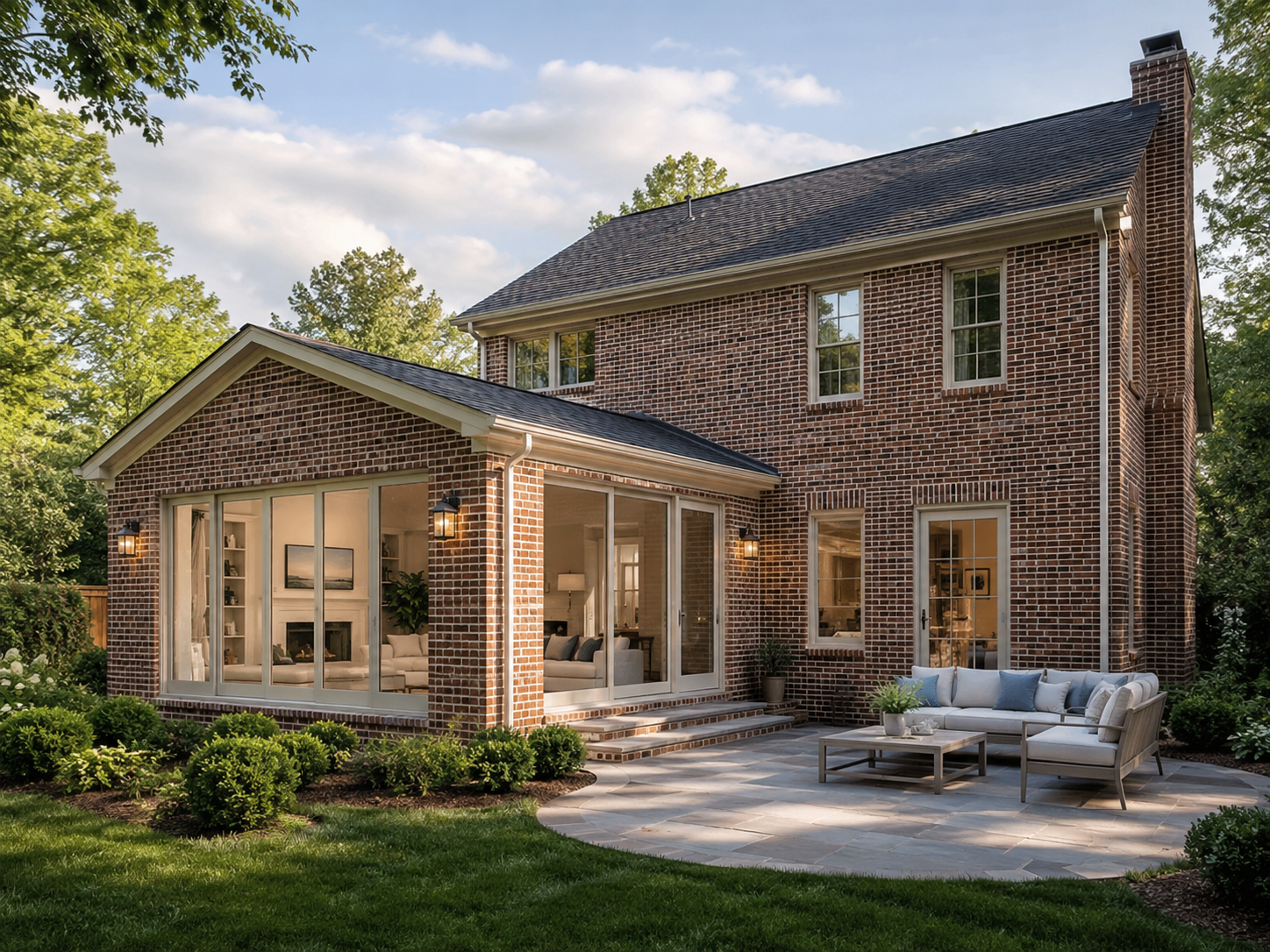
A full single-story addition creates a completely new room or series of rooms on a new foundation, with its own roofline, walls, and mechanical connections. This is the most common addition type for primary suites, family room expansions, sunrooms, and in-law suites.
Single room additions in Northern Virginia cost $300 to $500 per square foot. In Maryland, comparable additions run slightly lower — home additions in Maryland, Virginia, and DC typically cost between $100 and $300 per square foot. For a standard 500-square-foot addition, expect to invest $50,000 to $150,000 or more. In Montgomery County specifically, where permit fees for major additions can reach $8,000 to $12,000 and labor rates reflect the DC premium, total single-story addition costs at standard-to-premium specification regularly run $200,000 to $400,000 for meaningful new square footage.
Two-Story Additions
Two-story additions add square footage on two levels simultaneously — typically expanding the footprint on the first floor and adding a full upper-level bedroom and bathroom suite above.
In NOVA, second stories run $250–$500 per square foot because of structural reinforcement and stairs. Two-story additions best for maximizing square footage with minimal footprint have an investment range starting at $450 per square foot with an active construction timeline of 24–36 weeks. Because two-story additions require roof removal, complete upper-floor framing, and mechanical extension through two levels, they carry both the highest cost and the longest construction timeline of any addition type.
Primary Suite Additions
First-floor primary suite additions have become one of the most consistently requested addition types across both Maryland and Northern Virginia — driven by aging-in-place planning, multigenerational living needs, and the desire for accessible main-level sleeping without requiring stair navigation.
In-law or multigenerational suites have an investment range of $400–$650 per square foot with an active construction timeline of 14–20 weeks. In Maryland and Northern Virginia, a complete first-floor primary suite addition — with a bedroom, walk-in closet, and spa-quality bathroom — typically runs $200,000 to $400,000 depending on size, site conditions, and finish specification.
Sunroom and Four-Season Room Additions
Sunrooms and four-season rooms extend living space into the landscape without the full structural complexity of a traditional addition.
A high-quality, four-season sunroom addition in Northern Virginia typically ranges from $60,000 to $120,000. These rooms include full HVAC integration and high-efficiency glass, offering a year-round retreat with a 45% to 55% ROI. In Maryland, comparable four-season rooms run $55,000 to $110,000. These additions are particularly effective for Maryland and Northern Virginia homes where the rear yard creates a natural backdrop for an enclosed structure that functions as both a family room and a landscape connection.
Our Decks & Porches service coordinates with addition planning where an outdoor structure and an indoor addition are designed to work as an integrated system.
What Home Additions Cost in the DMV in 2026 — By Location
Location is the single most powerful cost variable in DMV addition pricing. Here is the honest breakdown by submarket.
Maryland — Montgomery County
Montgomery County sits at the premium end of the Maryland addition cost spectrum. Permit fees in Montgomery County can reach $8,000 to $12,000 for major additions, skilled labor commands premium wages, and material delivery costs more due to traffic and accessibility challenges.
For most Montgomery County addition projects:
Ground-floor single-story addition: $175 to $350 per square foot finished, with total project costs for a 500-square-foot addition running $90,000 to $175,000.
Two-story addition: $250 to $450 per square foot, with larger project totals of $200,000 to $400,000 for meaningful two-level expansion.
Primary suite addition (first floor, full bath): $200,000 to $350,000 at quality specification in Bethesda, Chevy Chase, and Potomac.
Northern Virginia — Fairfax County and Arlington
Northern Virginia addition costs reflect the DC metro labor premium and Fairfax County’s permit fee increases from mid-2025.
Home addition cost in Northern Virginia runs roughly $150 to $500 per square foot in 2026. A 1,000-square-foot addition here can range from about $130,000 to more than $250,000 before finishes and site conditions specific to your home are factored in.
Arlington and Alexandria push toward $250 to $500 per square foot because of their proximity to DC. In McLean, Great Falls, and the premium tier of Fairfax County, addition costs at high-end specification regularly approach or exceed $500 per square foot.
Washington DC
DC addition costs reflect the most premium labor market in the DMV, the District’s specific DOB permit process, and in many neighborhoods, historic preservation review requirements.
For planning purposes, most high-quality additions in the DMV fall between $450–$600+ per square foot. For DC rowhouse rear additions — the most common addition type in the District — plan for $300,000 to $600,000 for a meaningful rear extension that includes structural integration with the existing masonry building, new mechanical systems, and full interior finish.
The ROI Picture: What Additions Return at Resale
Understanding addition ROI requires honest framing of what the data shows — and what it doesn’t capture.
A well-planned addition typically adds $0.60–$0.80 for every dollar spent in the DMV area. For example, a $75,000 kitchen addition might increase home value by $52,000–$60,000, while a $42,000 bathroom addition could add $25,000–$29,000.
The addition types with the strongest ROI in the DMV market:
Bathroom additions that solve an under-bathed condition. A bathroom addition that fixes an under-bathed home — think: 4 bedrooms, 1 bathroom — almost always pencils out. Adding a fourth bath to a 4-bedroom, 3-bath home rarely does. The key is whether the addition solves a functional problem that buyers are discounting the home for, or simply adds a luxury that buyers wouldn’t pay meaningfully more to have.
Bedroom additions that bring the home to competitive bedroom count. In Maryland and Northern Virginia’s family-oriented markets, a home that is one bedroom short of the neighborhood standard consistently trades at a discount. Adding that bedroom — and the bathroom needed to serve it — recovers well at resale because it brings the home to the specification buyers in that price range expect.
Primary suite additions in markets where the existing primary bedroom is undersized. In Fairfax County and Montgomery County, where $600K–$800K homes are competing against newly built inventory with full primary suite configurations, a well-executed primary suite addition significantly closes the competitive gap.
Deck additions. Deck additions offer surprising value at 83% ROI. In Maryland and Northern Virginia’s four-season outdoor living market, a well-designed composite deck consistently recovers above 80% of cost at resale while delivering meaningful daily-use value during the holding period.
The Permit Process for Additions in Maryland and Northern Virginia
Additions are the most permit-intensive residential construction project type in the DMV — and navigating this process correctly is essential for projects of this scale.
Maryland — Montgomery County DPS. Addition permits in Montgomery County require complete structural engineering drawings, energy compliance documentation, and WSSC (water and sewer) review for any project involving plumbing connections. The Montgomery County DPS process for addition permits typically runs 6 to 10 weeks from complete, correctly prepared application submission. For projects involving a new foundation section, a sediment control permit is required before grading can begin.
Virginia — Fairfax County DPD. Fairfax County addition permits take 6 to 8 weeks for standard addition projects with structural drawings. For projects in planned communities with HOA architectural review requirements, HOA approval must be obtained before county permits are submitted.
Washington DC — DOB. DC addition permits typically take 4 to 8 weeks. For additions in historic districts — which covers much of Georgetown, Capitol Hill, Dupont Circle, Cleveland Park, and other areas — Historic Preservation Office review adds 6 to 12 weeks before the building permit is issued.
As fully Licensed Contractors in Maryland with active Virginia DPOR credentials and DC project experience, we manage all addition permit applications across every DMV jurisdiction as an integrated part of every project.
The Hidden Cost Categories Most Homeowners Miss
Beyond the construction estimate, DMV addition projects regularly surface cost categories that homeowners using national cost guides don’t account for:
Structural engineering: Required for every addition in Maryland, Virginia, and DC. Budget $1,500 to $5,000 for the engineering drawings needed for permit submission, depending on project complexity.
Site preparation and foundation: For addition projects on sloped sites, adjacent to mature trees, or in areas with clay soil conditions common across Maryland and Northern Virginia, site preparation and foundation work can add $15,000 to $40,000 beyond the standard per-square-foot addition cost.
Mechanical system expansion: HVAC, electrical panel capacity, and plumbing connections for a new addition often require system upgrades in the existing home — particularly in homes built before 1990. Budget $10,000 to $25,000 for mechanical integration.
Permit fees: Montgomery County: $8,000 to $12,000 for major additions. Fairfax County: $2,000 to $5,000 for standard addition permits. DC: $1,500 to $4,000 plus any historic review costs.
Contingency: 15 to 20% above the construction estimate. Additions consistently surface unexpected conditions — foundation irregularities, buried utilities, soil conditions, structural discoveries at the connection point between existing home and new addition.
H&C Construction Addition Projects Across the DMV
H&C Construction Design Build plans and builds home additions across Maryland, Washington DC, and Northern Virginia — including Montgomery County, Fairfax County, Arlington, Alexandria, and Washington DC. Our design-build model integrates design, structural engineering coordination, permit management, and construction under one accountable team — the approach that produces the most cohesive additions and the fewest budget surprises.
Browse completed projects across Maryland, DC, and Virginia in our Our Remodeling Projects portfolio.
Ready to Plan Your Home Addition?
Whether you’re planning a primary suite addition, a family room expansion, a sunroom, or a comprehensive Full Home Remodeling project that combines an addition with interior renovation, our design-build team is ready to give you an honest assessment, realistic cost range, and a plan that accounts for your specific location’s permit requirements and site conditions.
Request a consultation to start your addition project today.