

Home Remodeling in Silver Spring, Maryland: What Homeowners Need to Know in 2026
Silver Spring is Montgomery County’s most active remodeling community. In 2025, Silver Spring led the entire county in permit volume with 1,546 permits — more than Bethesda, more than Rockville, more than any other community in one of Maryland’s wealthiest and most renovation-active counties. That volume reflects something real: a community of homeowners deeply invested in improving the homes they already own, in a neighborhood they’ve chosen to stay in.
Silver Spring’s housing stock is one of the most diverse in the DMV. Mid-century Colonials and Cape Cods from the 1940s and 1950s sit alongside postwar ramblers, 1960s and 1970s split-levels, 1980s contemporaries, and newer infill construction in neighborhoods like Four Corners, Woodside, Burnt Mills Hills, and Downtown Silver Spring. Because of this diversity, Silver Spring remodeling looks different from Bethesda or Potomac — it spans a wider range of home types, project scales, and investment levels, and it rewards contractors who understand the specific realities of this market.
At H&C Construction Design Build, we serve homeowners throughout Silver Spring, Wheaton, Aspen Hill, Takoma Park, Kensington, and all of Montgomery County. Here’s what Silver Spring homeowners need to understand before planning a remodeling project in 2026.
Why Silver Spring Homeowners Are Investing Now
The motivations driving Silver Spring’s record permit volume are specific and understandable.
The lock-in effect is strong here. Most Silver Spring homeowners who purchased before 2022 hold mortgage rates well below 5%. Selling and buying a comparable home in the same school district or neighborhood at current rates would add hundreds of dollars per month to housing costs indefinitely. Because of this, remodeling is not just emotionally appealing — it is financially rational for a large share of Silver Spring’s homeowner base.
Silver Spring’s homes are reaching major remodeling age. Many of the mid-century Colonials, Cape Cods, and ramblers in Silver Spring were built in the 1940s through 1960s. These homes are now 60 to 80 years old — an age at which original kitchens, bathrooms, and mechanical systems have exceeded their practical service life. As a result, full room renovations rather than cosmetic updates are increasingly the appropriate investment.
The market rewards move-in readiness. With Montgomery County days-on-market rising to 30+ days in some Silver Spring sub-markets, renovated homes move faster and command meaningful premiums over unimproved comparable properties. In other words, remodeling before listing — specifically targeted kitchen and bathroom renovations — is creating measurable competitive advantage for Silver Spring sellers in 2026.
Interior renovations have outpaced additions two to one. Across Montgomery County, the ratio of interior renovations to home additions reached 2.4 to 1 by 2024 — meaning that for every family building out, nearly two and a half others are investing inward. Silver Spring’s permit volume reflects this trend clearly, with kitchen, bathroom, and basement projects leading activity.
Silver Spring’s Housing Stock: What Makes It Different
Understanding Silver Spring’s specific housing types helps homeowners plan more realistic renovation projects.
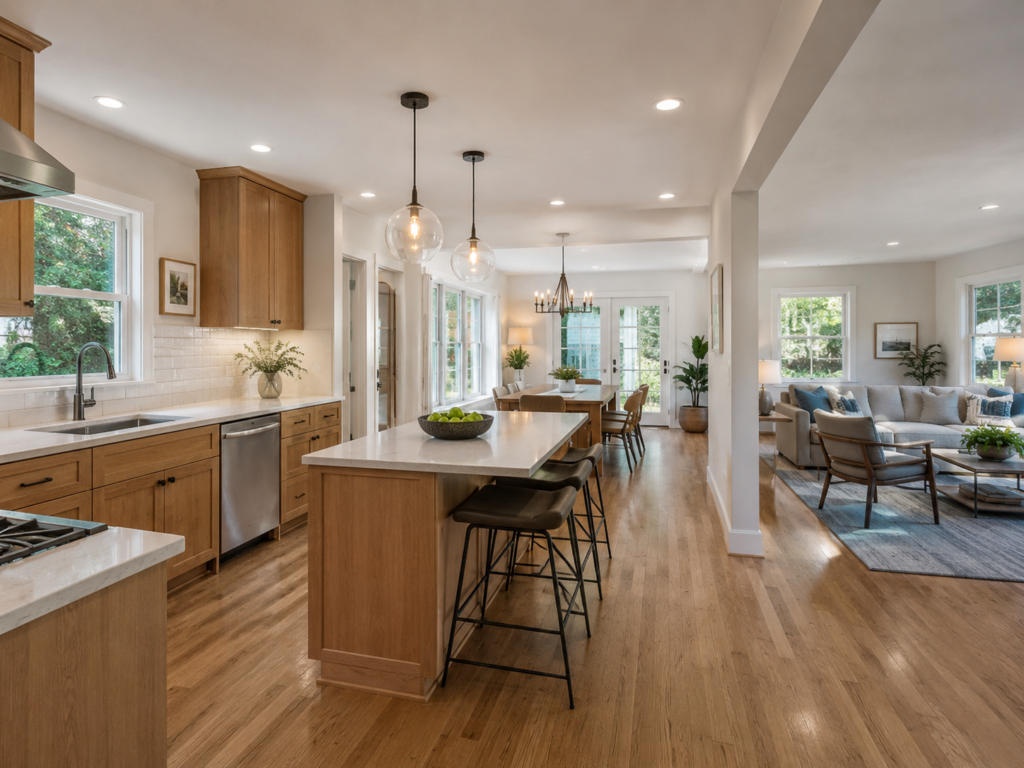
Mid-century Colonials and Cape Cods. These homes — typically built between 1940 and 1960 — are among the most remodeled in Silver Spring. They often feature compartmentalized main-floor layouts with separated kitchen, dining, and living rooms that feel dated by current open-concept standards. Opening these layouts is one of the most common renovation goals, and one that almost always involves structural work — load-bearing beam installation, electrical rerouting, and a building permit.
Split-level homes. Silver Spring and Wheaton have large concentrations of split-level homes built in the 1960s and 1970s. These homes present specific renovation challenges: staggered floor levels that complicate flooring continuity, distinct zones that are difficult to open without major structural work, and older mechanical systems that often need replacement during a renovation.
Ramblers and ranch homes. Single-story ramblers in Aspen Hill and Four Corners offer excellent candidates for main-level primary suite additions and accessible aging-in-place renovations, because they already have all living space on one level.
What older Silver Spring homes typically reveal during renovation. Opening walls in a 1950s or 1960s Silver Spring home regularly surfaces conditions that need to be addressed — and budgeted for — before finish work proceeds. Knob-and-tube or aluminum wiring that requires replacement. Cast iron drain lines. Galvanized water supply pipes. Subfloor moisture from decades of slow infiltration. Inadequate insulation. None of these are unusual — but each adds cost that should be anticipated, not discovered as a surprise.
A 15% contingency above any renovation estimate is not excessive for a Silver Spring home built before 1980. It is accurate planning.
What Remodeling Projects Cost in Silver Spring in 2026
Costs in Silver Spring span a wide range, reflecting the market’s diversity of home types and investment levels.
Kitchen Remodeling in Silver Spring
Kitchen remodeling in Silver Spring typically runs:
- Minor refresh: $35,000 to $60,000 — cabinet refacing, new countertops, updated lighting, new fixtures
- Mid-range full renovation: $55,000 to $100,000 — full cabinet replacement, new countertops, updated appliances, updated electrical, and possibly a modest layout adjustment
- Full renovation with layout change: $80,000 to $140,000 — includes structural work to open the kitchen into a dining or living area
In Four Corners and Woodside — Silver Spring’s higher-value sub-neighborhoods — kitchen renovations trend toward the upper end of each tier, because buyer expectations there align more closely with Bethesda than with Wheaton or Aspen Hill.
In Wheaton and Aspen Hill, where home values are more modest, kitchen investments optimized for resale ROI should be calibrated to neighborhood price comparables. Over-improving beyond what comparable sold homes support in a given micro-market consistently reduces return. Our Kitchen Remodeling team provides honest guidance on where the right investment level sits for your specific property.
Bathroom Remodeling in Silver Spring
Bathroom remodeling in Silver Spring typically runs:
- Secondary or hall bathroom: $12,000 to $30,000 — tile replacement, vanity replacement, fixture update, shower or tub conversion
- Primary suite bathroom: $25,000 to $55,000 — custom tile shower, new double vanity, updated lighting, frameless glass
- Luxury primary suite: $55,000 to $80,000+ — premium stone, spa features, heated floors, full reconfiguration
Many Silver Spring bathrooms were installed during the home’s original construction and have not been touched beyond cosmetic paint or fixture replacements. As a result, full gut renovations — removing everything down to the studs and rebuilding — are common and often necessary to address the moisture damage and deferred maintenance that accumulate behind decades-old tile.
Our Bathroom Remodeling team serves homeowners throughout Silver Spring with mid-range and premium bathroom renovations that address what’s behind the walls, not just the visible surfaces.
Basement Finishing in Silver Spring
Many Silver Spring homes — particularly ramblers, split-levels, and Colonials — have unfinished or partially finished basements that represent significant untapped value. Finishing a Silver Spring basement typically runs $55,000 to $110,000 depending on scope and whether a bathroom and legal bedroom egress window are included.
Silver Spring’s housing density and lot sizes make basement finishing particularly attractive as an alternative to costly additions, because expanding outward is often constrained by lot coverage limits and setbacks. A finished basement is consistently the best cost-per-square-foot path to additional livable space in this market.
Our Basement Remodeling team handles full basement finishing projects across Silver Spring, including egress window installation for legal bedroom creation.
Permitting in Silver Spring: Montgomery County Requirements
All remodeling projects in Silver Spring fall under the Montgomery County Department of Permitting Services jurisdiction. Because Silver Spring has no independent municipal permit process — unlike Rockville, which is an incorporated city with its own permit office — all permits are pulled from the county DPS.
Any Silver Spring project involving electrical work, plumbing changes, structural modifications, or new square footage requires permits. The most common permit types for Silver Spring remodeling projects are building, electrical, and plumbing permits — each requiring separate applications and inspections under Montgomery County’s current process.
As fully Licensed Contractors in Maryland, we manage all permit applications and coordinate all required inspections for Silver Spring projects — so homeowners never navigate the Montgomery County DPS process independently.
One important distinction for Silver Spring homeowners: because permit timelines in Montgomery County typically run six to eight weeks for mid-range residential projects, planning the permit application as part of the project’s upfront phase — not as something that happens after design is finalized — is essential for realistic schedule management.
The Most Popular Remodeling Projects in Silver Spring in 2026
After years of completing projects across Silver Spring’s neighborhoods, several renovation types consistently top the request list.
Open-concept kitchen conversions. Many Silver Spring homeowners with 1940s to 1960s Colonials or Cape Cods want to remove or open the wall between the kitchen and dining room — creating the open main level that wasn’t part of the original design. This is among the most transformative projects available in Silver Spring’s housing stock, and one that requires structural planning but delivers a result that changes how the home functions daily.
Primary bathroom gut renovations. Most Silver Spring primary bathrooms from the original construction period feature pink, beige, or harvest gold tile, shallow tub-shower combos, and vanities that were never designed for daily use by two adults. A full gut renovation that replaces everything — and that converts the tub-shower to a curbless walk-in shower — is the most consistently satisfying bathroom investment in this market.
Basement conversions to home office and guest suites. Silver Spring’s proximity to DC makes it a home base for federal employees, contractors, and professionals who work frequently from home. Dedicated office space in a finished basement — with proper acoustic separation from main household activity — is one of the most practical investments available in this market, and one that consistently generates strong daily-use ROI alongside resale value.
Whole-home multi-room renovation. Silver Spring’s aging housing stock increasingly rewards homeowners who approach renovation comprehensively — addressing flooring, lighting, trim, and system upgrades across the full home rather than one room at a time. A coordinated Full Home Remodeling project delivers the material consistency and aesthetic cohesion that piecemeal renovations rarely achieve.
Urban Transitional: Silver Spring’s Dominant Design Aesthetic in 2026
Silver Spring’s character — a mix of historic mid-century homes, diverse community identity, and proximity to DC’s urban culture — produces a specific design preference that experienced local contractors recognize.
The dominant style in Silver Spring renovations in 2026 is what designers are calling “Urban Transitional.” This approach honors Silver Spring’s traditional Maryland architectural heritage — brick, hardwood floors, classic trim profiles — while integrating clean contemporary lines, warm natural materials, and industrial-inspired fixture choices.
In practice, this means:
- Warm white oak or walnut cabinetry rather than stark painted white
- Quartz countertops with subtle movement and warm undertones rather than stark white surfaces
- Matte black hardware and fixtures rather than polished chrome
- Large-format porcelain tile rather than small mosaic patterns
- Recessed lighting and sculptural pendants rather than builder-grade flush mounts
This aesthetic ages well, appeals broadly across buyer demographics, and photographs well in real estate listings — making it the right choice for Silver Spring homeowners regardless of whether they’re renovating for long-term living or eventual resale.
Ready to Plan Your Silver Spring Remodel?
H&C Construction Design Build serves homeowners throughout Silver Spring, Wheaton, Aspen Hill, Takoma Park, Kensington, Four Corners, and all of Montgomery County. As a General Contractor in Maryland with deep experience in Montgomery County’s housing stock, permitting process, and local design standards, our design-build team is ready to give you an honest assessment and a plan built for this specific community.
Explore our Kitchen Remodeling, Bathroom Remodeling, and Full Home Remodeling services and request a consultation to start planning your Silver Spring project today.
Free consultation
Ready to Start Your Full Home Remodeling Project?
H&C Construction serves Maryland, Virginia, and Washington DC. Get a free consultation today.
Local service areas
Remodeling Guides Near You
Planning home renovation in Montgomery County? Browse local guides by city — permits, neighborhoods, and recent H&C Construction projects.
City hubs