
Home Remodeling in Northwest DC: What Homeowners in Woodley Park, Cleveland Park, Chevy Chase DC, and Tenleytown Need to Know in 2026
Northwest DC’s upper quadrant contains some of Washington’s most gracious residential neighborhoods. Woodley Park’s pre-war brick rowhouses and detached Colonials along Connecticut Avenue. Cleveland Park’s Tudor revivals and craftsman bungalows from the 1910s and 1920s. Chevy Chase DC’s elegant detached Colonials and stone Tudors near Western Avenue. Tenleytown and American University Park’s mid-century and post-war stock. Spring Valley’s and Wesley Heights’ larger estate homes set on generous lots. Together, these communities represent a residential character that is quieter and less frenetic than the dense rowhouse blocks of Georgetown and Capitol Hill — but no less architecturally significant or complex when it comes to renovation.
Because of this, homeowners in these Northwest DC neighborhoods benefit from contractors who understand the specific realities of their housing stock, their DC Department of Buildings permit process, and the Historic Preservation review requirements that apply to some — but not all — properties in this part of the city.
At H&C Construction Design Build, we serve homeowners throughout Washington DC including Woodley Park, Cleveland Park, Chevy Chase DC, Tenleytown, American University Park, Spring Valley, Wesley Heights, Glover Park, and all Northwest DC neighborhoods. Here is what you need to know before starting a renovation in 2026.
The Housing Stock That Defines These Neighborhoods
Northwest DC’s upper quadrant neighborhoods were primarily developed in the 1910s through 1950s — slightly later than Georgetown and Capitol Hill, and in a more suburban pattern that produced more detached and semi-detached homes alongside the rowhouse stock that defines the rest of the city.
Woodley Park contains an exceptional concentration of pre-war brick rowhouses, detached Colonials, and apartment buildings along Connecticut Avenue and the streets east and west of it. Many Woodley Park rowhouses are one hundred years old or older. After demolition is complete in older Woodley Park homes, the infrastructure — framing, plumbing, and electrical wiring — should be evaluated carefully before assuming it was previously updated. In practice, after demolition reveals older construction methods, updating corroded cast-iron pipes or bringing old electrical systems up to modern safety codes becomes part of the renovation scope.
Cleveland Park features a distinctive mix of Tudor revival homes, craftsman bungalows, and Victorian-influenced detached houses that give the neighborhood its reputation for architectural eclecticism. Cleveland Park properties attract homeowners who value the neighborhood’s tree canopy, its walkable Connecticut Avenue corridor, and its position within easy reach of Rock Creek Park. Renovations in Cleveland Park must balance the architectural character of each individual home — and the neighborhood’s design sensibility — against the functional improvements that modern family life requires.
Chevy Chase DC — the DC side of the Chevy Chase community — is characterized by detached Colonials, center-hall Tudors, and stone homes from the 1910s through 1940s on larger lots than most of DC’s rowhouse neighborhoods. Because of this, Chevy Chase DC properties frequently have more room for rear additions than the dense rowhouse blocks of Capitol Hill or Georgetown. Additionally, many Chevy Chase DC properties sit near the DC-Maryland line, and some fall within Montgomery County’s jurisdiction rather than the District’s — making address verification of the correct permitting authority an essential first step before any renovation planning begins.
Tenleytown and American University Park contain a more diverse mix of housing types — pre-war detached homes, post-war Colonials and ramblers, and mid-century construction that has been improved and maintained by an active homeowner community with close ties to American University. Renovation in these neighborhoods often involves homes that were last updated in the 1980s or 1990s, with finishes and systems that are dated but structurally sound.
Spring Valley and Wesley Heights represent the upper tier of Northwest DC’s residential market — larger estate homes, some exceeding 4,000 square feet, on larger lots in a park-like setting. Renovation in Spring Valley and Wesley Heights operates at investment levels consistent with the neighborhood’s home values, with kitchen and bathroom projects that regularly exceed $150,000 at high-end specification.
The Historic Preservation Framework in These Neighborhoods
One of the most important questions for any Northwest DC homeowner planning a renovation involving exterior changes is whether their property is in a designated historic district.
Cleveland Park Historic District covers a significant portion of Cleveland Park’s pre-war housing stock. Properties within this district that are contributing resources require Historic Preservation Review Board (HPRB) review and approval before any exterior changes proceed. In practice, this includes window replacement, door changes, roofing material changes, porch modifications, and any exterior addition visible from a public right-of-way.
Chevy Chase DC and other NW neighborhoods are not uniformly in historic districts. However, individual properties anywhere in DC can be individually designated as landmarks even outside formal historic district boundaries. Before any exterior work is designed, confirming the historic status of the specific address through the DC Office of Planning’s Historic Preservation Office is essential.
Interior renovations generally bypass HPRB review across all of these neighborhoods. Full kitchen remodels, bathroom gut renovations, basement finishing, and structural interior changes that don’t affect the home’s exterior appearance typically do not require historic preservation review. Because of this, many homeowners in Cleveland Park and Woodley Park complete comprehensive interior transformations — opening the main level, upgrading all systems, adding spa-quality bathrooms — without triggering the HPRB process at all.
What Renovation Looks Like in Northwest DC’s Homes
The renovation goals and challenges in these neighborhoods reflect the character of their specific housing types.
Opening Compartmentalized Pre-War Layouts
Pre-war homes throughout Woodley Park, Cleveland Park, and Chevy Chase DC were built with formal, separated room hierarchies — distinct parlors, dining rooms, and kitchens that reflect the social conventions of their era. Today’s homeowners consistently want these spaces to flow — to move from the kitchen to the dining area to the living space without boundaries. Because of this, main-level wall removal is one of the most requested structural changes across all of these neighborhoods.
In detached homes with balloon framing or masonry bearing walls, this structural work requires engineering. However, the result — a continuous, light-filled main level that works for how modern families actually live — is consistently among the most transformative results available in this housing stock.
Kitchen Renovation in Northwest DC Homes
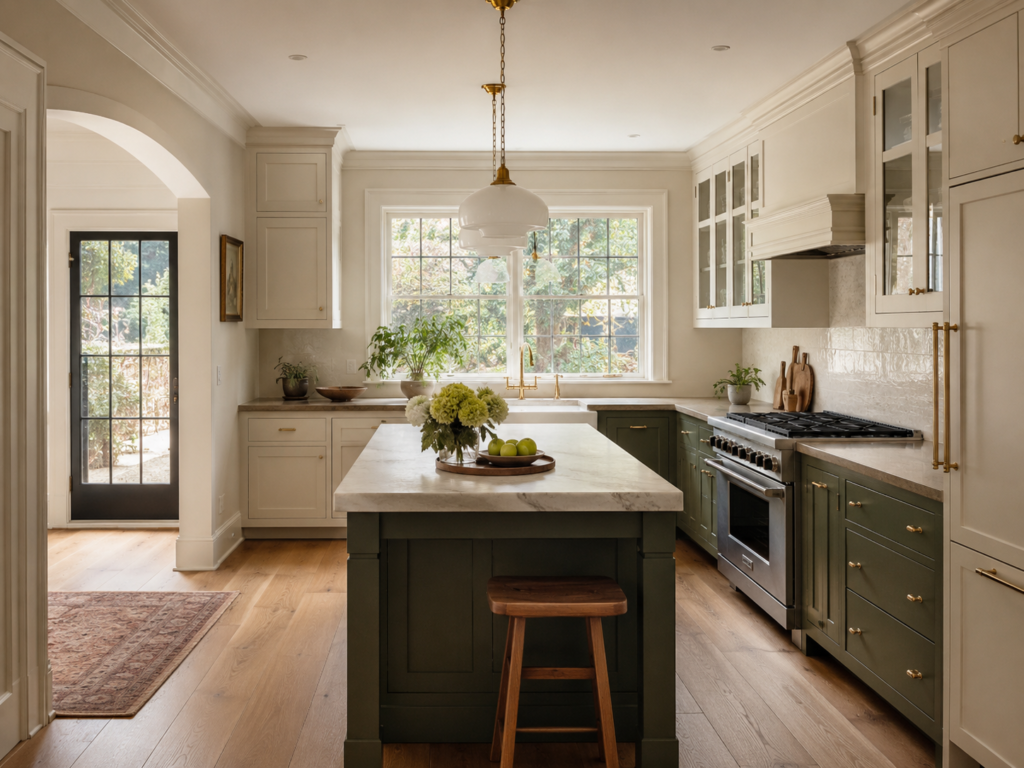
Kitchen renovation in Woodley Park, Cleveland Park, and Spring Valley homes operates across a wide range of investment levels. Minor cosmetic refreshes run $40,000 to $60,000. Mid-range gut renovations run $75,000 to $120,000. High-end custom kitchens in Spring Valley and Wesley Heights estate homes regularly exceed $200,000. NW DC home styles range from elegant detached Colonials in Chevy Chase and Friendship Heights to pre-war brick rowhouses in Cleveland Park and Woodley Park — each requiring specific knowledge of DC building regulations and the construction methods appropriate to each housing type.
Successful kitchen renovation in these older homes addresses not just the visible finishes but the invisible infrastructure. Updated electrical capacity for modern appliances, refreshed plumbing supply and drain lines, and properly installed ventilation for contemporary range hoods are all components of a renovation that will perform well for decades rather than simply looking good at completion.
Our Kitchen Remodeling service covers every scope in Northwest DC, coordinated with any structural or historic review requirements.
Bathroom Renovation
Bathrooms in Cleveland Park and Woodley Park’s 100-year-old homes carry challenges typical of their era. Cast iron plumbing, inadequate subfloor thickness for modern large-format tile, and electrical systems that predate current code requirements are common findings once demolition begins. However, because bathroom renovation opens these systems naturally, addressing them during the renovation scope is both the most efficient and most cost-effective approach.
In Woodley Park specifically, a master bathroom renovation of an awkward, narrow pre-war space requires creative design that maximizes function within a constrained footprint — choosing large-format tile for shower walls and floor, frameless glass panels, and custom vanities that make the most of available dimensions. Our Bathroom Remodeling team serves Northwest DC homeowners with spa-quality bathroom renovations calibrated to these homes’ specific conditions.
Basement Conversion
Northwest DC’s detached and semi-detached homes frequently have basement levels with meaningful potential. Basements hold untapped potential for work, rest, and gathering. Successful basement conversion in these homes addresses moisture, light, ceiling conditions, and safe access from the start — so the space feels welcoming and connected to the rest of the house. Homeowners gain flexibility without expanding the footprint, and the addition of a legal bedroom or home office adds measurable value at resale.
Our Basement Remodeling team handles full basement conversions across Northwest DC.
Additions in Northwest DC
For detached homes in Chevy Chase DC, Spring Valley, and Wesley Heights, rear additions are the most common expansion type. Additions provide the space families need when existing layouts can no longer keep up. Thoughtfully designed new square footage connects naturally with the original house, integrating structure, exterior materials, and interior transitions so the addition reads as a cohesive part of the home rather than an obvious afterthought. These projects create opportunities to improve light, flow, and organization while preserving neighborhood character.
For Cleveland Park properties in the historic district, additions require HPRB coordination before any permit can be submitted. Our Home Additions team manages the full process for Northwest DC addition projects.
What Renovation Costs in These Neighborhoods in 2026
Renovation costs across Northwest DC’s upper quadrant reflect DC’s premium labor market and the specific conditions of older construction.
Interior renovation only (kitchen + bathrooms + systems): $150,000 to $400,000 for a comprehensive gut renovation across a typical Northwest DC pre-war home — main level reconfiguration, new kitchen, two or three bathroom renovations, mechanical systems replacement, and finish work throughout.
Full renovation with rear addition: $300,000 to $600,000+ depending on addition size, HPRB coordination where applicable, and finish specification level.
Standalone kitchen renovation: $75,000 to $120,000 mid-range; $150,000 to $200,000+ in Spring Valley and Wesley Heights estate homes.
Contingency: 15 to 20% above the construction estimate for any project in a home built before 1960 in these neighborhoods. Because older construction consistently surfaces deferred maintenance and out-of-code conditions once work begins, budgeting for discovery honestly is accurate planning rather than pessimism.
The DC DOB Permit Process for These Neighborhoods
All renovation permits for Northwest DC properties are processed through the DC Department of Buildings (DOB) via the online Permit Wizard or ProjectDox systems. For properties in the Cleveland Park Historic District, HPRB review precedes the building permit submission.
Standard residential renovation permits: 4 to 8 weeks from complete application to issuance for projects not involving historic review.
Projects in the Cleveland Park Historic District: 6 to 10 weeks for HPRB review, followed by 4 to 8 weeks for DC DOB permit review — total pre-construction regulatory time of 12 to 18 weeks for exterior scopes.
Lead paint requirements: Virtually all homes in these neighborhoods predate 1978. Federal EPA Lead RRP regulations require all contractors working in these homes to hold valid certification and follow required containment and disposal protocols. Our team holds all required certifications on every DC project.
H&C Construction in Northwest DC
H&C Construction Design Build serves homeowners throughout Northwest DC — including Woodley Park, Cleveland Park, Chevy Chase DC, Tenleytown, American University Park, Spring Valley, Wesley Heights, Glover Park, and all surrounding NW neighborhoods. Our design-build model coordinates design, HPRB coordination where required, DC DOB permitting, and construction under one accountable team.
Browse completed renovation projects across DC and the broader DMV in our Our Remodeling Projects portfolio.
Ready to Plan Your Northwest DC Renovation?
Whether you’re planning a kitchen transformation, a bathroom renovation, a basement conversion, or a Full Home Remodeling project across your entire home, our design-build team is ready to give you an honest assessment and a realistic plan built for your specific neighborhood.
Request a consultation to start the conversation today.
Free consultation
Ready to Start Your Full Home Remodeling Project?
H&C Construction serves Maryland, Virginia, and Washington DC. Get a free consultation today.
Local service areas
Remodeling Guides Near You
Planning home renovation in Montgomery County? Browse local guides by city — permits, neighborhoods, and recent H&C Construction projects.
City hubs