
Full Home Remodeling in Bethesda, Maryland: How to Choose the Right Contractor and What to Expect in 2026
Bethesda is one of the most demanding whole-home remodeling markets in the entire DMV — and one of the most rewarding when projects are executed well. With a median home value exceeding $1.4 million in 2026, Bethesda homeowners who undertake comprehensive renovations are making investments of $200,000 to $600,000+ into homes whose underlying asset value fully justifies that scope. However, this is also the market where renovation failures are most visible and most costly — where a poorly managed multi-room renovation in Edgemoor or Kenwood can fall short of the finish standard that comparable homes in those neighborhoods set, reducing the return on a substantial investment.
The most common thing that goes wrong in Bethesda whole-home renovations is not a single bad decision — it is a structural planning failure at the beginning. In the Bethesda area, a single-room renovation typically runs about $15,000 to $50,000, a multi-room remodel about $75,000 to $200,000, and a whole-home or gut renovation about $200,000 to $600,000 or more — roughly $100 to $300+ per square foot. These ranges reflect what happens when planning is right. When planning is wrong, the overruns compound across multiple rooms, multiple trades, and multiple permit types simultaneously — in the most time-sensitive and budget-sensitive renovation category available.
At H&C Construction Design Build, we plan and build Full Home Remodeling projects across Bethesda and all of Montgomery County. Here is what Bethesda homeowners need to know before starting a whole-home renovation in 2026.
What Drives Bethesda Homeowners Toward Whole-Home Renovation
Bethesda is full of late 20th century single-family homes — many of which feature faded fixtures, finishes, and floor plans which have fallen out of favor. The specific circumstances that most consistently drive Bethesda homeowners toward comprehensive renovation rather than targeted single-room projects:
The piecemeal renovation trap. Many Bethesda homeowners begin with a kitchen renovation, follow with a primary bathroom, then plan a third project — and eventually discover that tackling rooms sequentially over 5 to 8 years costs significantly more than a coordinated whole-home renovation plan would have. Each sequential project requires its own design fees, its own permit applications, its own setup and cleanup, and its own disruption period. A coordinated multi-room renovation, executed under one plan with one contractor and one permit package, is consistently more efficient in both time and total cost.
Floor plan limitations that no single room solves. In Bethesda’s late-20th-century Colonial housing stock, the kitchen, dining room, and family room are frequently separated in ways that no amount of kitchen renovation alone addresses. Opening these spaces into each other requires structural work that simultaneously affects multiple rooms — making it inherently a whole-main-level project rather than a targeted kitchen project.
System replacement that opens everything anyway. Bethesda homes from the 1970s and 1980s frequently reach a point where electrical panel replacement, partial plumbing repiping, and HVAC updates are all due simultaneously. When walls must be opened for system access, the incremental cost of completing room finishes while walls are open is significantly lower than opening finished walls again later.
What Full Home Renovation Costs in Bethesda in 2026
The Bethesda whole-home renovation cost range is genuinely wide — because project scope varies enormously.
Multi-room cosmetic refresh (no structural changes, no system replacement): $75,000 to $175,000. Updating finishes in multiple rooms — kitchen cabinet fronts and countertops, bathroom vanities and tile, new flooring throughout, fresh paint — without touching structural or mechanical systems.
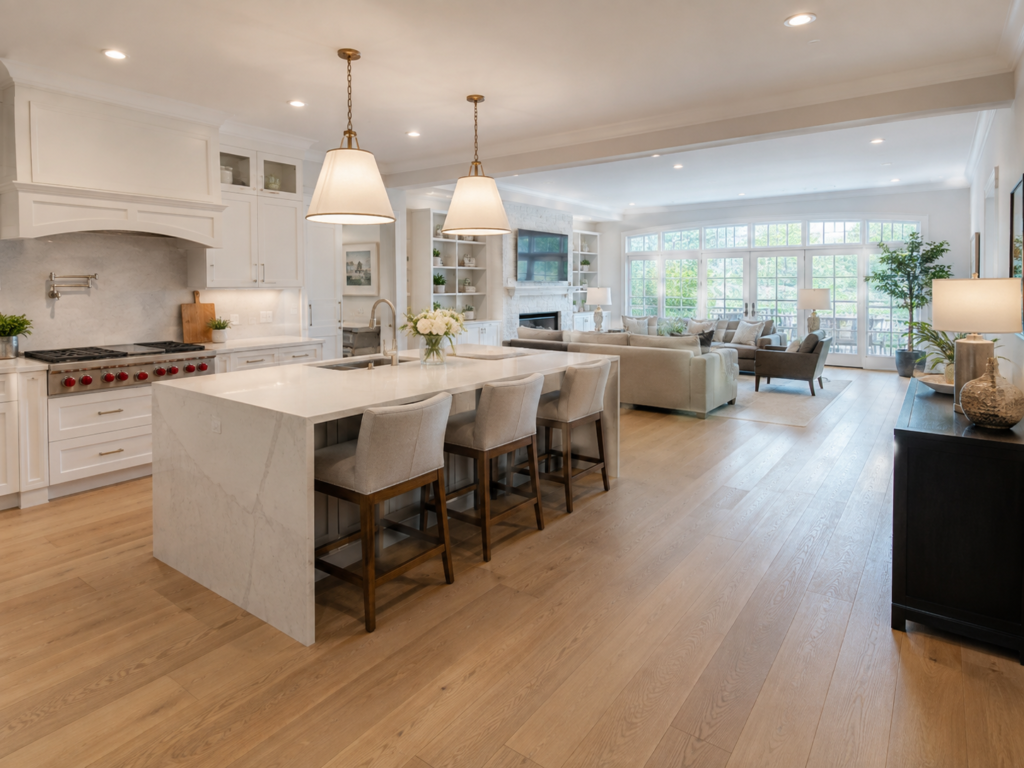
Comprehensive renovation (kitchen gut, bathroom guts, main-level structural, partial system updates): $200,000 to $400,000. This is the most common whole-home renovation scope for Bethesda homeowners planning a lasting transformation. A comprehensive renovation addresses both the visible finishes and the functional limitations of an aging home — opening the main level, replacing all kitchen and bathroom finishes, and updating the systems that are showing age.
Full gut renovation ($300 per sq ft+): $400,000 to $600,000+ for a thorough full gut renovation of a 2,000 to 2,500 square foot Bethesda Colonial — including structural work, all system replacement, all layouts reconsidered, and high-quality finishes throughout. For Bethesda homes built before 1980 that haven’t been renovated in 20 or more years, this is the scope that produces a genuinely new-condition home within the existing structure.
Permit fees add meaningfully to these figures. Bethesda residential remodels file with Montgomery County DPS. The typical permit cycle runs 5 to 8 weeks for major work, 2 to 3 weeks for straightforward scopes. Egress windows, stormwater management, and HPC review where applicable add 2 to 4 weeks. Permit fees for a comprehensive renovation package — building, electrical, plumbing, and mechanical — run $3,000 to $8,000 for most Bethesda whole-home projects.
The Contractor Selection Decision — The Most Important Choice in a Bethesda Whole-Home Renovation
Many Bethesda renovation projects begin with excitement and end in frustration — unclear budgets, design changes mid-build, or results that don’t match the vision. The right contractor eliminates those surprises by focusing on planning, architectural clarity, and construction precision before the first wall is opened.
The design-build advantage is most powerful in whole-home renovation. When a renovation spans multiple rooms, multiple permit types, and multiple trade specialties simultaneously, the coordination gap between a separate designer and a separate general contractor is not merely inconvenient — it is the primary source of the budget overruns and timeline surprises that characterize unsuccessful renovation projects. A design-build firm integrates all of these elements under one contract. Because of this, cost implications of design decisions are identified in real time during design — not weeks later when construction bids reveal the gap.
MHIC license and insurance — non-negotiable. Every Maryland home improvement contractor must hold an active MHIC license, verifiable at dllr.state.md.us. Since June 1, 2024, Maryland law requires minimum $500,000 general liability insurance for all Maryland home improvement contractors. For a Bethesda whole-home renovation at $200,000 to $600,000+, confirming adequate insurance coverage is not optional.
Montgomery County DPS permit track record. A contractor who manages Montgomery County DPS permit submissions regularly knows the specific requirements, submission standards, and common rejection causes for this particular permit office. Ask specifically: “How many Montgomery County permits have you submitted in the past 12 months, and what is your first-submission approval rate?” An experienced contractor at Montgomery County DPS consistently achieves first-submission approval — saving 3 to 6 weeks on the project timeline.
References from comparable Bethesda whole-home projects. Portfolio images are the beginning of contractor evaluation, not the end. Call three references from completed whole-home renovations in Bethesda or comparable Montgomery County communities from the past two years. Ask specifically: Did the final cost match the original estimate? How were unexpected discoveries handled? Would you hire this contractor again for a project of this scale?
The Bethesda Whole-Home Renovation Process — What to Expect
Phase 1 — Comprehensive pre-design assessment (2 to 4 weeks). Unlike a single-room renovation where pre-design assessment is relatively straightforward, a whole-home renovation requires a thorough assessment of structural conditions, mechanical system status, and permit requirements across all planned scope areas. In Bethesda’s pre-1990 housing stock, this assessment regularly identifies electrical, plumbing, and structural conditions that must be factored into the scope before any design begins.
Phase 2 — Integrated design development (4 to 10 weeks). Whole-home renovation design involves coordinating floor plan decisions, cabinet specifications, material selections, structural solutions, and mechanical system plans across all rooms simultaneously. The most important discipline of this phase: all material selections — cabinetry, tile, countertops, flooring, fixtures — must be finalized before permit applications are submitted, because last-minute changes after permitting cause scope revisions that extend both timeline and cost.
Phase 3 — Permit applications (5 to 8 weeks). A comprehensive whole-home renovation permit package for Bethesda typically includes building, electrical, plumbing, and mechanical permits submitted to Montgomery County DPS as a complete set. A complete, correctly prepared submission moves through review in 5 to 8 weeks. An incomplete submission resets the clock.
Phase 4 — Phased construction (3 to 9 months). Whole-home renovation construction sequences rooms to minimize disruption to livable space and to coordinate trade inspections efficiently. Structural work and rough-in trades go first, followed by insulation and drywall, followed by finish work in each room. Most Bethesda homeowners remain in their homes during renovation with one section completed and habitable while another is under construction.
Phase 5 — Closeout and punch list (2 to 4 weeks). Final inspections across all permitted trade types, punch list completion, final walkthrough, and project documentation.
HOA Considerations in Bethesda Whole-Home Renovations
Many Bethesda subdivisions have HOA architectural review. An experienced Bethesda contractor prepares board-ready submission packages for any exterior elements requiring HOA approval. Importantly, most whole-home renovation scope is interior — structural changes, systems, kitchen, bathrooms, flooring — and does not require HOA review. However, any exterior element included in a whole-home renovation scope — new windows, deck or patio additions, changes to roofline or siding — must pass HOA architectural review before Montgomery County DPS permits are submitted.
Confirming exactly which elements of a planned whole-home renovation scope require HOA review — and sequencing that review correctly before permit submission — is a project planning discipline that experienced Bethesda contractors build into the process automatically.
H&C Construction — Full Home Remodeling Contractor in Bethesda, Maryland
H&C Construction Design Build serves Bethesda homeowners planning comprehensive whole-home renovations across Edgemoor, Kenwood, Westmoreland Hills, Bradley Hills, Burning Tree, Battery Park, Woodmont, and all Bethesda neighborhoods.
As a Licensed Contractor in Maryland, we hold active MHIC licensure, current EPA Lead RRP certification, and general liability insurance above Maryland’s $500,000 statutory minimum. We manage all Montgomery County DPS permit applications across every trade type as part of every whole-home renovation project.
Browse completed whole-home and multi-room renovation projects in our Our Remodeling Projects portfolio.
Ready to Plan Your Bethesda Whole-Home Renovation?
Whether you’re planning a multi-room cosmetic refresh, a comprehensive renovation addressing both finishes and functional limitations, or a full gut renovation of a Bethesda home that hasn’t been updated in decades, our design-build team gives you an honest scope assessment and realistic cost range before any commitment.
Explore our Full Home Remodeling service and request a consultation to start your Bethesda whole-home renovation today.
Free consultation
Ready to Start Your Full Home Remodeling Project?
H&C Construction serves Maryland, Virginia, and Washington DC. Get a free consultation today.
Local service areas
Remodeling Guides Near You
Planning home renovation in Montgomery County? Browse local guides by city — permits, neighborhoods, and recent H&C Construction projects.
City hubs