
Design-Build Home Remodeling in Maryland, Washington DC, and Virginia: Why 2026 Homeowners Want One Accountable Contractor From Planning to Final Build
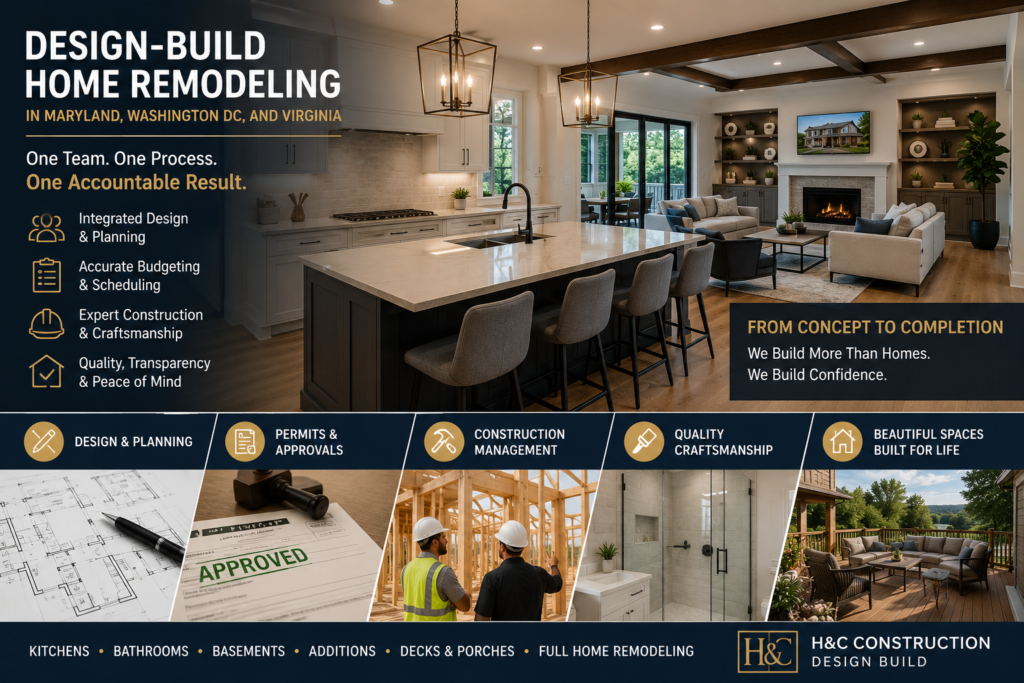
Design-build home remodeling is becoming one of the most strategic choices for homeowners in Maryland, Washington DC, and Virginia. In 2026, homeowners are not only searching for beautiful kitchens, spa bathrooms, finished basements, home additions, and outdoor living spaces. They are also searching for confidence.
They want a remodeling process that feels organized.
They want one accountable contractor.
They want design decisions, construction feasibility, materials, permits, sequencing, and craftsmanship to work together from the beginning.
That is why design-build home remodeling in Maryland, DC, and Virginia is becoming such a powerful approach for serious homeowners across Rockville, Bethesda, Potomac, Silver Spring, Chevy Chase, Gaithersburg, Washington DC, Arlington, Alexandria, Fairfax, and Northern Virginia.
A design-build approach helps homeowners avoid the common problem of fragmented remodeling: one designer, one architect, one contractor, separate trades, unclear communication, changing budgets, and decisions that are made too late.
Current renovation guidance continues to emphasize the value of planning with a whole-home master plan instead of renovating piecemeal. Designers and architects recommend aligning structural, mechanical, aesthetic, and budget decisions early to avoid rework and create cohesive homes that feel intentional rather than patched together.
At H&C Construction Design Build, we help homeowners remodel with structure, craftsmanship, communication, and long-term value. If your home needs more than a surface update, start with Full Home Remodeling, explore our role as a General Contractor in Maryland, or view Our Remodeling Projects.
What Is Design-Build Remodeling?
Design-build remodeling is a project delivery approach where planning, design direction, construction feasibility, material coordination, trade management, and execution are handled through one integrated process.
Instead of separating design decisions from construction realities, design-build connects them from the start.
A design-build remodeling process may include:
- Initial consultation
- Home condition review
- Scope definition
- Layout planning
- Budget alignment
- Material direction
- Permit planning
- Construction sequencing
- Trade coordination
- Quality control
- Final walkthrough
The value is accountability.
When the remodeling process is fragmented, homeowners often face gaps between what is designed, what is permitted, what is buildable, and what fits the budget. Design-build reduces that gap by making the project more coordinated.
This matters especially for Home Additions, Full Home Remodeling, Kitchen Remodeling, Bathroom Remodeling, and Basement Remodeling because these projects require multiple decisions to work together.
Why DMV Homeowners Need a More Coordinated Remodeling Process
Homes across Maryland, Washington DC, and Virginia often have unique remodeling challenges.
Many properties have older layouts, aging materials, limited storage, small bathrooms, unfinished basements, outdated kitchens, aging decks, older electrical planning, and additions that may have been built years ago under different standards.
A homeowner may want a new kitchen, but the project may also affect:
- Flooring
- Lighting
- Electrical systems
- Plumbing
- Wall openings
- Dining layout
- Outdoor access
- Pantry storage
- Ventilation
- Permit requirements
A homeowner may want a finished basement, but the project may require:
- Moisture evaluation
- Egress planning
- Insulation
- Lighting
- Bathroom feasibility
- Flooring strategy
- Ventilation
- Storage
- Ceiling height review
A homeowner may want a home addition, but the project may involve:
- Foundation
- Roofline integration
- Exterior materials
- HVAC coordination
- Drainage
- Structural framing
- Windows
- Permits
- Interior flow
This is why a coordinated design-build process is stronger than making decisions room by room without a master plan.
A strong remodel should not feel improvised.
It should feel intentional from concept to completion.
Design-Build Helps Protect the Budget
One of the biggest homeowner frustrations in remodeling is budget uncertainty.
Budgets become harder to control when design ideas are not connected to construction reality. A beautiful concept may become expensive if structural work, plumbing changes, electrical upgrades, or permit requirements are discovered too late.
A design-build process helps homeowners evaluate the project more realistically.
It connects:
- Desired outcome
- Scope of work
- Existing home conditions
- Construction complexity
- Material choices
- Trade coordination
- Permit needs
- Sequencing
- Long-term value
This does not mean every project becomes inexpensive. Serious remodeling requires serious investment.
But it does mean the homeowner can make smarter decisions earlier.
For example, a homeowner may decide whether the right path is a full kitchen expansion, a smarter pantry wall, a home addition, or a whole-first-floor remodel. That decision should be made before demolition begins.
This is especially important for Kitchen Remodeling, where layout, cabinetry, countertops, lighting, flooring, appliances, and plumbing all affect budget.
Design-Build Improves Communication
A successful remodel depends on communication.
Homeowners need to understand what is happening, why it is happening, and how decisions affect the project.
Design-build improves communication because the project is not passed from one disconnected party to another. The team can align design intent, construction execution, trade coordination, and homeowner expectations.
This helps reduce common problems such as:
- Unclear scope
- Conflicting recommendations
- Material delays
- Design decisions that do not fit the home
- Poor sequencing
- Rework
- Budget surprises
- Miscommunication between trades
- Delayed decisions
- Inconsistent quality
For homeowners in Maryland, DC, and Virginia, this is important because remodeling projects often involve both design decisions and regulatory requirements.
A professional General Contractor in Maryland should help homeowners understand the project from a construction standpoint, not only from a decorative standpoint.
Design-Build Is Especially Valuable for Home Additions
Home additions are one of the strongest examples of why design-build matters.
A home addition is not just “adding a room.”
It affects the structure, exterior, interior, roofline, foundation, drainage, HVAC, electrical systems, windows, doors, flooring, lighting, and how the home flows.
A design-build Home Addition may create:
- Larger kitchen
- Primary suite
- First-floor suite
- Family room
- Sunroom
- Mudroom
- Home office
- Guest suite
- Expanded bathroom
- Indoor-outdoor living area
The addition must feel like part of the home.
A poorly planned addition can look disconnected, create awkward transitions, or fail to solve the family’s actual needs. A well-planned addition can transform how the entire home works.
This is why design-build planning should begin before finalizing layout, finishes, or construction timing.
Design-Build Creates Stronger Kitchen Remodeling Results
Kitchen remodeling is one of the most valuable remodeling categories because the kitchen affects daily living, entertaining, storage, family routines, and resale perception.
A design-build kitchen remodel can coordinate:
- Layout
- Cabinetry
- Island size
- Pantry storage
- Appliance placement
- Lighting
- Electrical outlets
- Flooring
- Plumbing
- Ventilation
- Dining connection
- Outdoor access
Many homeowners focus first on cabinets and countertops. But the best kitchens start with layout and function.
A strong Kitchen Remodeling project should answer practical questions before materials are chosen:
- Where does the family cook?
- Where does food storage belong?
- Is the island helping or blocking traffic?
- Is there enough lighting?
- Is the kitchen connected to dining and outdoor spaces?
- Does the home need a pantry, butler’s pantry, or prep zone?
- Should the kitchen be expanded or reconfigured?
Design-build makes those decisions more disciplined.
Design-Build Makes Bathroom Remodeling Safer and More Durable
Bathroom remodeling is not only tile and fixtures.
A bathroom contains plumbing, waterproofing, ventilation, electrical work, drainage, lighting, and moisture-sensitive materials. A beautiful bathroom can fail if construction details are weak.
A design-build Bathroom Remodeling project can coordinate:
- Walk-in shower layout
- Waterproofing
- Drain placement
- Tile selection
- Ventilation
- Vanity storage
- Lighting
- Slip-resistant flooring
- Curbless shower feasibility
- Aging-in-place features
- Plumbing coordination
This is especially important for wet rooms, spa bathrooms, primary bathrooms, and accessible bathrooms.
A bathroom should look beautiful, but it should also perform for years.
Design-Build Helps Basements Become Real Living Space
A basement remodel can add major usable space, but only if the project is planned correctly.
A design-build Basement Remodeling project should consider:
- Moisture
- Insulation
- Egress
- Ceiling height
- Lighting
- Flooring
- Ventilation
- Bathroom feasibility
- Storage
- Laundry areas
- Family room layout
- Guest suite planning
The biggest mistake is treating a basement like a normal above-grade room.
Basements need performance-first planning.
If there are signs of water damage, musty odors, damaged flooring, or foundation concerns, Restoration & Rebuild may be the correct first step before finishes are installed.
Design-Build Connects Outdoor Living With the Home
Outdoor spaces are becoming more important in the DMV.
Homeowners want decks, porches, covered patios, outdoor kitchens, screened porches, safer stairs, better railings, and outdoor lighting that feel connected to the home.
A design-build Decks & Porches project can coordinate:
- Deck structure
- Porch rooflines
- Outdoor lighting
- Stairs and railings
- Kitchen-to-outdoor flow
- Exterior materials
- Drainage
- Safety
- Seating areas
- Covered spaces
- Outdoor cooking zones
Outdoor living should not feel like an afterthought.
A strong deck or porch should feel like an extension of the house.
Why Licensed Contractors Matter in Maryland, DC, and Virginia
Homeowners should treat contractor selection as a serious risk-management decision.
Maryland states that only MHIC licensed contractors may enter into contracts with homeowners to perform home improvement work, and Maryland’s licensing FAQ says each contractor who solicits or performs home improvement services in Maryland must hold an MHIC license.
In Washington DC, the Department of Buildings regulates construction activity through permits, document review, inspections, and code and zoning compliance.
In Virginia, contractor licensing is overseen by DPOR’s Board for Contractors, with Class A, B, and C contractor licensing categories.
For homeowners, the lesson is clear: serious remodeling should be handled by qualified professionals.
Explore Licensed Contractors in Maryland if you want to understand why licensing, accountability, and professional standards matter before starting a project.
When Should You Choose Design-Build Remodeling?
Design-build remodeling may be the right approach if your project includes:
- Multiple rooms
- Layout changes
- Home additions
- Kitchen remodeling
- Bathroom remodeling
- Basement finishing
- Deck or porch construction
- Structural work
- Permit requirements
- Material coordination
- Whole-home upgrades
- Aging-in-place planning
- Storm damage rebuild
- Outdoor living integration
The more complex the project, the more valuable coordination becomes.
If the remodel affects how the home functions, looks, and performs, it should be planned with a professional design-build mindset.
How H&C Construction Design Build Helps DMV Homeowners
At H&C Construction Design Build, we help homeowners move from scattered ideas to a structured remodeling plan.
Our design-build approach focuses on five priorities.
1. Understanding the Homeowner’s Goals
We begin by learning what the homeowner wants to improve: space, comfort, layout, storage, safety, entertaining, outdoor living, or long-term value.
2. Evaluating the Existing Home
We review the home’s current layout, materials, structural concerns, moisture risks, exterior conditions, and remodeling opportunities.
3. Planning the Right Scope
We help homeowners decide whether the project should focus on full-home remodeling, home additions, kitchens, bathrooms, basements, decks, porches, or restoration.
4. Coordinating Construction Professionally
We manage construction with attention to sequencing, materials, trades, communication, quality control, and finish details.
5. Building for Long-Term Value
We focus on remodeling that looks beautiful, functions better, and supports the home for years.
Whether you need full-home remodeling in Bethesda, a home addition in Potomac, kitchen remodeling in Rockville, basement remodeling in Silver Spring, or outdoor living upgrades in Northern Virginia, H&C Construction can help you remodel with purpose.
View Our Remodeling Projects to start planning.
Build With One Clear Plan, One Accountable Process, and Long-Term Value
Design-build home remodeling gives homeowners a stronger way to remodel.
Instead of separating design from construction, it connects planning, feasibility, materials, permits, sequencing, craftsmanship, and communication into one more accountable process.
In 2026, homeowners in Maryland, Washington DC, and Virginia need remodeling partners who can think beyond one room and understand the full home.
If your home needs more space, better layout, a modern kitchen, safer bathroom, finished basement, outdoor living, or a complete transformation, H&C Construction Design Build can help you move from idea to execution with confidence.
Explore Full Home Remodeling, Home Additions, Kitchen Remodeling, Bathroom Remodeling, and General Contractor in Maryland, with H&C Construction Design Build today.
Free consultation
Ready to Start Your Full Home Remodeling Project?
H&C Construction serves Maryland, Virginia, and Washington DC. Get a free consultation today.
Local service areas
Remodeling Guides Near You
Planning home renovation in Montgomery County? Browse local guides by city — permits, neighborhoods, and recent H&C Construction projects.
City hubs