
Finished Basement vs. Home Office Addition in Maryland: Which Upgrade Works Better for Modern Living?
For Maryland homeowners, the need for more functional space has changed. It is no longer only about adding square footage for a growing family. Today, many renovation decisions are driven by remote work, hybrid schedules, guest flexibility, privacy, storage, and the need to make the home perform better every day.
That is why one of the smartest questions homeowners can ask is this: should you invest in a basement remodeling project or build a home addition specifically designed as a home office or multi-purpose workspace?
Both options can solve the same core problem, but they do so in very different ways. One uses the structure you already have. The other creates new above-grade square footage. One may be more budget-efficient. The other may feel more premium, visible, and integrated into the main living environment.
The right choice depends on what kind of space you need, how private it must be, how often it will be used, and whether your long-term priority is flexibility, resale appeal, or true expansion.
Why This Decision Matters More Than Ever
The home office is no longer a luxury feature for a small percentage of homeowners. It has become a practical part of modern living. Even for families that do not work remotely full time, there is still growing demand for spaces that support focused work, school routines, video calls, quiet reading, admin tasks, and flexible guest use.
This is why the decision should not be reduced to “which option gives me another room?” The better question is which upgrade creates the most useful kind of room for your lifestyle.
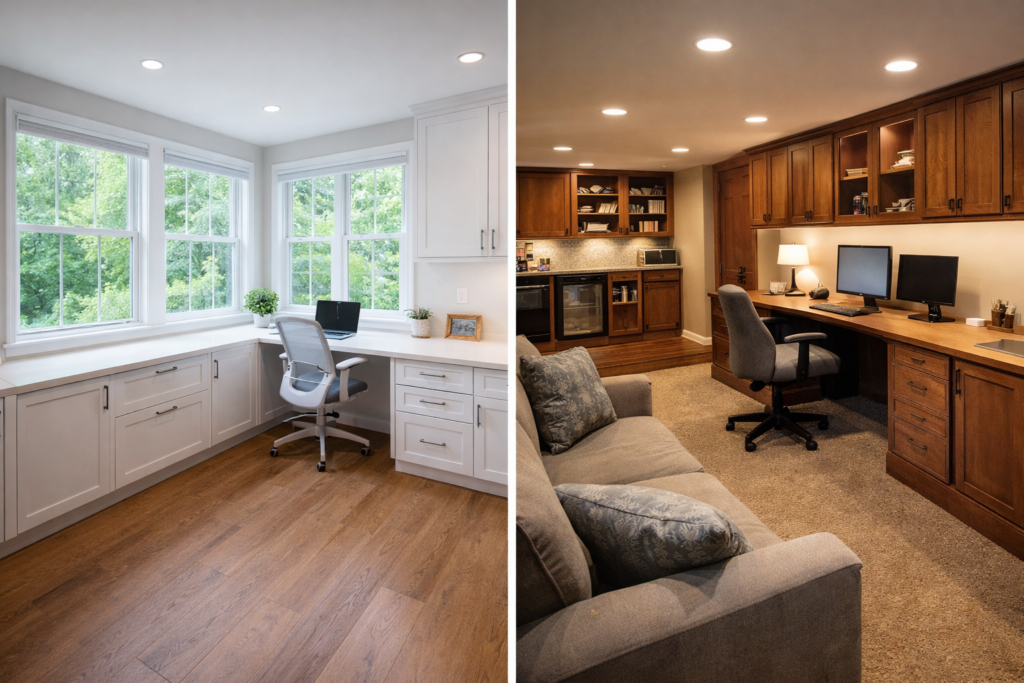
For some households, finishing the basement is the best answer because it creates a quieter separation from the main floor. For others, a dedicated office addition feels more natural because it brings natural light, easier daily access, and stronger long-term design value.
When a Finished Basement Makes More Sense
A basement remodeling project is often the stronger choice when the home already has underused lower-level space with good potential for conversion.
This approach is ideal when you need:
- a quiet workspace separated from the busiest parts of the house
- a flexible area that can also serve as a guest zone, gym, lounge, or media room
- more function without expanding the home’s exterior footprint
- a renovation that builds on existing structural space rather than starting from scratch
A basement office can work especially well for remote professionals who need fewer interruptions during the day. It can also be a smart choice when the goal is not just one office, but a multi-use lower level that supports work, relaxation, and future adaptability at the same time.
The biggest advantage is versatility. A basement is rarely limited to one purpose. With the right layout, lighting, storage, and finish strategy, it can support a home office now and still function as additional living space later.
If that lower level also needs a bathroom or more comfort for guests, it can naturally connect with future bathroom remodeling decisions as part of a broader lower-level upgrade.
When a Home Office Addition Is the Better Investment
A home addition is often the better move when the house truly lacks enough above-grade space and the new office needs to feel fully integrated into the main living environment.
This option makes more sense if you want:
- a dedicated office with strong natural light
- direct access from the main level without using basement stairs
- a space that feels more premium and visible within the home
- a long-term expansion that clearly increases the home’s usable footprint
- a room that may later serve as a bedroom, library, studio, or private suite component
A home office addition tends to feel more intentional because it is designed from the ground up for that purpose. It can be placed exactly where it supports your floor plan best. It may also create a stronger emotional impression because above-grade square footage typically feels more connected to the core living experience of the home.
If your current main floor already feels tight, this route may be much more effective than finishing the basement, because it solves both the need for an office and the bigger issue of limited usable space.
Privacy, Noise, and Daily Function
One of the biggest differences between these two options is how they affect concentration and privacy.
A basement office often wins on separation. It physically removes the workspace from kitchen traffic, TV noise, front-door activity, and the constant flow of daily family life. That can be a major benefit for professionals who spend hours on calls, need uninterrupted focus, or simply want a cleaner boundary between work and home.
An office addition often wins on comfort and accessibility. It usually provides easier access, more natural light, and a stronger sense of connection to the rest of the house. For homeowners who want a workspace that feels bright, polished, and easy to use throughout the day, that can matter just as much as privacy.
So the real comparison is not just basement versus addition. It is separation versus visibility, quiet versus integration, and value-focused flexibility versus premium expansion.
Cost Logic: Build Within the Home or Expand the Structure?
In many cases, basement remodeling is more cost-efficient because the structure already exists. You are working within the home’s footprint instead of extending it.
That usually means fewer exterior construction demands, less structural expansion, and a project scope that can be more manageable when the goal is to gain usable space efficiently.
A home addition often costs more because it involves structural expansion, exterior integration, framing, roofing, and a more complex building sequence. But that added complexity can also create a more premium and visible result if what you truly need is new above-grade square footage.
This is where planning matters. A homeowner who only needs a strong, private workspace may find that the basement is the smarter investment. A homeowner whose entire house feels undersized may find that an addition solves the deeper issue more effectively.
Resale and Long-Term Flexibility
From a resale perspective, both upgrades can be valuable, but they communicate value differently.
A finished basement tends to appeal through flexibility. Buyers see space they can use as a lounge, office, gym, guest retreat, media area, or secondary living zone. The more polished and functional the lower level feels, the stronger its value perception becomes.
A home office addition tends to appeal through permanence and premium square footage. Buyers usually understand an addition immediately. It feels like a visible expansion of the home rather than a conversion of existing space.
That said, the best resale result usually comes from fit. If your neighborhood and house layout support an addition well, that may be the stronger long-term move. If your basement has excellent potential and the main home already functions well above grade, then finishing the basement may create more practical value without overextending the project.
If the bigger issue is that multiple areas of the house need rethinking at the same time, the smarter path may be full home remodeling rather than evaluating one isolated room decision at a time.
Which Option Is Better for Modern Living in Maryland?
Choose basement remodeling first if your priority is flexible use, privacy, and better value from the home’s existing footprint.
Choose home additions first if your priority is above-grade space, natural light, and a more visibly integrated expansion.
And if your office need is only one part of a much larger issue, such as outdated circulation, insufficient storage, or disconnected main living areas, it may be worth reviewing whether kitchen remodeling or a broader full home remodeling strategy would solve more than one problem at once.
This is why the best renovation decisions are rarely made by comparing rooms alone. The right decision comes from understanding how the entire home is used.
The Real Success Factor: Planning, Sequencing, and Execution
Whether you choose a basement office or an addition, the success of the project depends on planning. Layout, lighting, comfort, electrical needs, storage, acoustics, finish quality, and long-term adaptability all matter.
That is where working with a general contractor in Maryland becomes critical. The best results come from clear scope definition, smart sequencing, clean trade coordination, and a finish standard that makes the new space feel intentional rather than improvised.
Without that structure, even a good concept can turn into a disconnected project that underperforms in daily life.
Ready to Choose the Right Office Upgrade?
If you are deciding between a finished basement and a home office addition in Maryland, the next step is a professional evaluation of your layout, priorities, and long-term goals.
Explore the most relevant service pages here:
- Basement Remodeling
- Home Additions
- General Contractor Maryland
- Full Home Remodeling
- Bathroom Remodeling
- Kitchen Remodeling